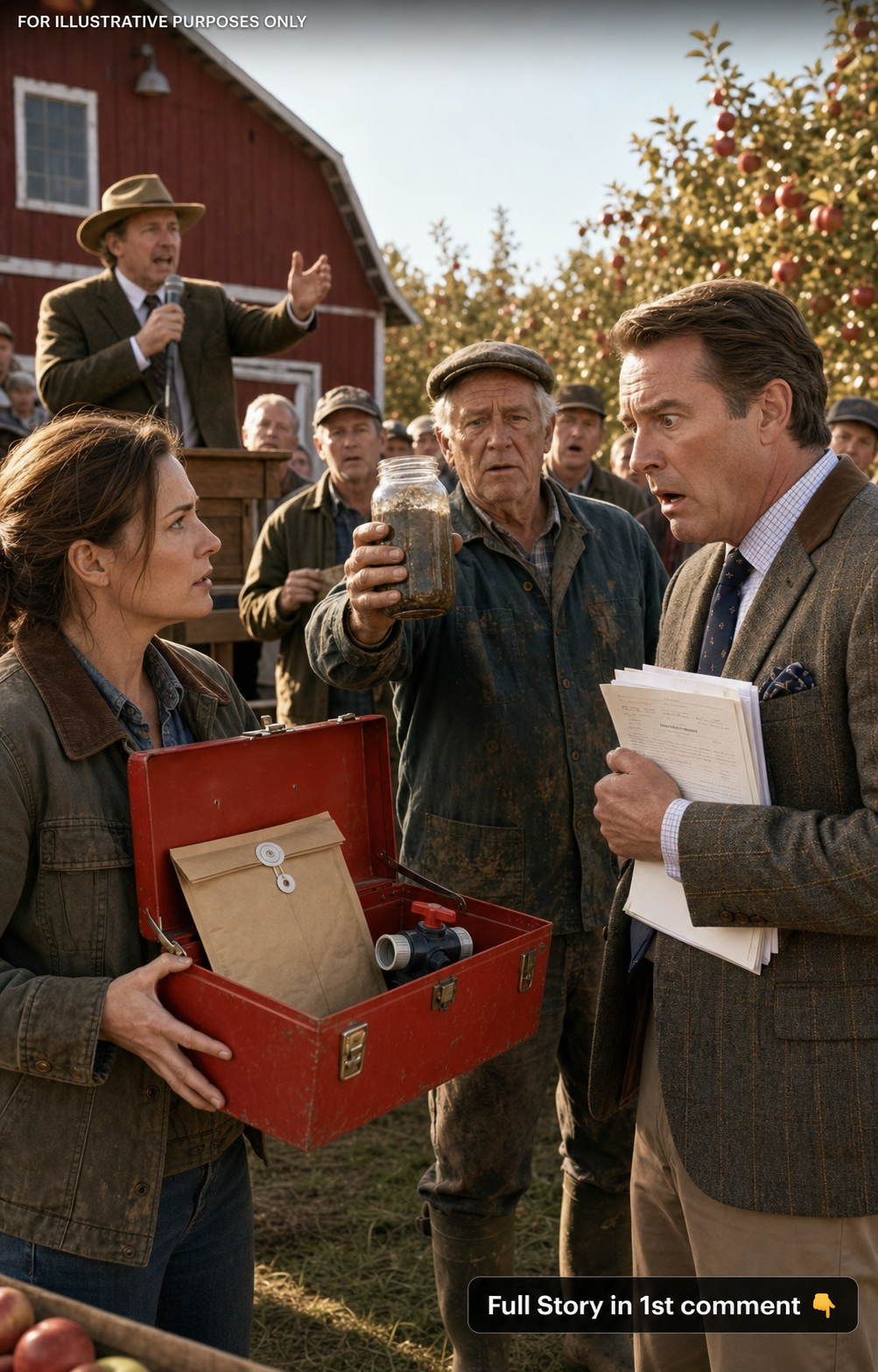
The registered bidder was North Vale Holdings, a company created only eleven days earlier. Its mailing address belonged to Roland’s accountant, and its only manager was Roland’s wife. He had arranged to sell the orchard cheaply to a company his own household controlled, but that still did not explain the dying trees. Eli opened Dad’s letter. Months before his death, Dad noticed that entire rows were weakening while trees supplied by another irrigation branch remained healthy. He sent soil and water samples to an independent agricultural laboratory. The results found no contagious disease. Instead, the affected line contained abnormal contamination consistent with deliberate interference. Dad ordered a replacement valve marked with a distinctive scratch, photographed it, and locked it in the red toolbox. Before he could install it, he entered the hospital. When Eli later checked the irrigation shed, the unused replacement was gone—and a valve with the same scratch had appeared on a hidden bypass line.
The bypass allowed material from a small auxiliary tank to enter only the rows Roland wanted the appraiser to see. Investigators later determined that a concentrated agricultural mixture had been used to damage roots and imitate severe decline. Dad’s report warned that the trees could recover if the line was shut down quickly, but Roland hid the report and commissioned a second appraisal based solely on the damaged rows. He then used that low valuation to persuade the bank that an emergency auction was necessary. Eli had grown suspicious when Roland forbade workers from entering the pump shed. The night before the sale, he photographed the bypass, collected a sealed sample, and found the toolbox beneath sacks in Roland’s private storage room. We stopped the auction and contacted the county agricultural investigator. Roland claimed the equipment was ordinary, until his purchasing records showed that he had ordered the auxiliary tank under North Vale Holdings.
The court suspended Roland as trustee. A forensic review uncovered emails between him and the accountant discussing how the orchard could be resold to a developer once the “disease problem” frightened away local bidders. He expected to buy more than two hundred acres through North Vale, remove the trees, and sell the land in parcels for several times the auction price. The bank had never known he controlled the bidder. When confronted with the laboratory results, financial records, and Eli’s photographs, Roland agreed to a civil judgment and later pleaded guilty to fraud-related charges and environmental violations. North Vale’s registration was canceled, the forced-sale process was withdrawn, and Roland was ordered to cover the cleanup and part of the crop loss. The orchard was not magically healed, but specialists believed most of the affected trees could survive with clean irrigation and careful pruning.
Recovery took three seasons. Neighbors volunteered during the first harvest, the bank restructured the legitimate debt, and Eli trained me to notice the small changes Dad had always seen before anyone else. We placed part of the land in an agricultural conservation trust so no future trustee could quietly turn the orchard into a subdivision. The red toolbox now sits in the packing barn beside Dad’s original report. I never repaired the scratch on the valve. Every autumn, when the damaged rows produce fruit again, I think about how close we came to losing everything because a lie was presented with an official appraisal and an auctioneer’s microphone. Roland believed sick-looking trees would make the land appear worthless. He forgot that roots keep records of what they are given—and that one honest man with a muddy jar can sometimes make an entire crowd stop bidding long enough to hear the truth.





Leave a Reply