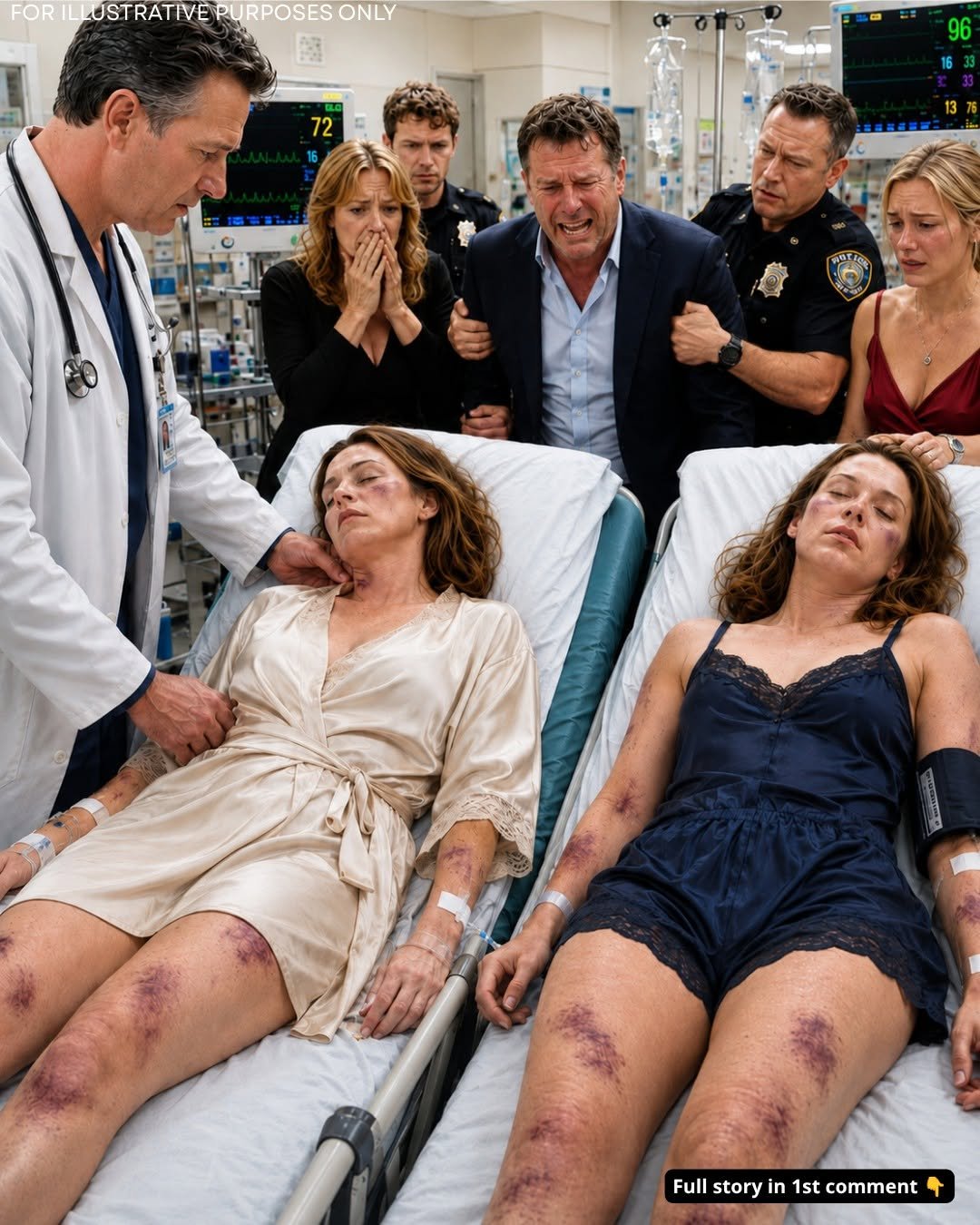
My stepfather abused my twin sister and me every single day because our fear entertained him. One night, he beat us until we lost consciousness, then hauled us into the emergency room while my mother quietly claimed, “They fell down the stairs.” After examining the matching bruises covering our bodies, the doctor locked the door and instructed the security guard, “Call 911, immediately.”
The final thing I heard before everything went black was my twin sister, Lily, screaming my name. The last image burned into my mind was our stepfather smiling as though her panic was applause.
Raymond Vale never hit us in a moment of anger. Everything was deliberate. He selected the time, drew the curtains shut, removed his wedding ring, and told our mother to raise the television volume. Then he positioned Lily and me side by side and decided which of us would suffer first.
We were seventeen years old, identical enough to confuse most teachers, yet Raymond never mixed us up. Lily pleaded. I remained silent. My refusal to react was what he hated most.
“Still pretending you’re brave, Mara?” he asked that evening.
I tasted blood and answered, “No. I’m remembering.”
His smile slipped for a brief moment.
What he didn’t know was that three months earlier, I had discovered an old phone hidden among Christmas decorations. The screen was damaged, but the microphone still functioned. Every night, I concealed it beneath a loose floorboard near the heating vent. The recordings automatically uploaded to a private cloud account our late father had created years before.
Our father, Daniel Cross, had worked as a forensic accountant. Before his death, he placed his life-insurance funds and company shares into a trust for Lily and me, accessible when we turned eighteen. Raymond believed our mother controlled the trust, and she never corrected him.
Following Dad’s funeral, Uncle Adrian warned us that money attracted dangerous people, but he was stationed overseas, and Celeste slowly cut off communication. Raymond told neighbors we were unstable and ungrateful. By the time we realized his plan, he had already built a prison out of locked doors, humiliation, and convincing lies.
That night, he became careless. Lily tried to protect me, and he slammed her into the wall. I rushed at him. The room spun the moment his fist struck my temple.
When I opened my eyes, harsh fluorescent lights glared overhead. Lily was unconscious in the bed beside me. Raymond stood calmly near the curtain, washing his hands. Our mother, Celeste, gripped her purse and quietly told the emergency physician, “They fell down the stairs.”
Dr. Elias Grant studied the bruises along my arms before comparing them to the identical marks on Lily. His expression changed immediately.
“Both girls fell the same way?” he asked.
Raymond folded his arms. “Teenagers lie. Treat them.”
Dr. Grant stepped into the hallway, locked the examination-room door from the outside, and spoke to the security guard.
“Call 911, immediately.”
Raymond laughed. “You have no idea who you’re accusing.”
A faint voice came from Lily’s bed.
“He will soon.”
Her eyes opened. Mine filled with tears.
We had survived long enough for the trap to snap shut.
PART 2
Police separated us before Raymond could get near the exit. He shouted that he was a respected property developer, that he donated money to the mayor, and that the hospital would regret embarrassing him. Celeste cried harder than anyone else, yet she never once asked if Lily or I could breathe without pain.
Detective Sofia Bennett sat beside my hospital bed.
“Can you tell me what happened?”
Raymond’s attorney had already arrived outside. I could hear him demanding entry.
I kept my voice calm. “I can show you.”
I gave her the password to the cloud account.
There were eighty-seven recordings.
The first captured Raymond calling us parasites. The seventh recorded Celeste reminding him not to leave bruises before school picture day. The thirty-second contained Lily begging our mother for help.
The final recording captured everything, including Celeste saying, “Hit the quieter one first. Mara watches too closely.”
Detective Bennett stopped the audio.
Her jaw tightened.
But the most disturbing discovery came from documents stored alongside the recordings. Weeks earlier, after overhearing Raymond arguing about our trust, I searched his office. I photographed forged medical evaluations declaring Lily and me mentally incompetent, along with petitions naming Raymond our permanent financial guardian.
He intended to take control of forty-two million dollars the moment we turned eighteen.
Dr. Grant returned with a hospital social worker and confirmed another detail: our injuries existed in multiple stages of healing. This was not a single incident. It was an ongoing pattern.
Raymond still believed money could erase the truth.
From the hallway, he called out, “Mara, tell them your sister started a fight. I’ll forgive you.”
I looked at Detective Bennett.
“May I answer?”
She opened the door while standing between us.
Raymond flashed the smile he always wore before hurting us.
“Be smart.”
“I was,” I replied. “That’s why every word you said for three months is already with the police.”
His expression went blank.
Celeste staggered backward.
“You recorded us?”
Lily sat upright despite the nurse’s objections.
“You taught us to be quiet, Mom. You never taught us to be helpless.”
Raymond’s lawyer fell silent.
By sunrise, investigators had searched our home, Raymond’s office, and a storage unit rented under Celeste’s maiden name. They uncovered forged signatures, sedatives, burner phones, and surveillance photos of our trust attorney. They also discovered a draft life-insurance policy Raymond had attempted to purchase on both of us.
He had not only planned to steal our inheritance. According to messages recovered from his laptop, he intended to stage a deadly car accident after gaining guardianship.
The detective read one message aloud.
“Two girls, one brake failure, no questions.”
For the first time, Celeste looked frightened of him.
Raymond immediately turned on her.
“You wrote that.”
She screamed, “You promised they would only be declared unstable!”
Their partnership crumbled in less than a minute.
Detective Bennett watched them blame one another before placing handcuffs on both.
As Raymond was escorted away, he twisted toward me.
“You think you won?”
I held Lily’s hand.
“No,” I said. “I think you finally lost.”
PART 3

Three weeks later, Raymond entered the county courthouse. Their attorneys argued that the recordings had been manipulated and that two traumatized teenagers had fabricated everything to gain early access to their trust fund.
They expected Lily and me to break under pressure during the preliminary hearing.
Instead, we arrived with Dr. Grant, Detective Bennett, our trust attorney, and Uncle Adrian. Adrian had stepped aside from the trust but helped investigators track Raymond’s network of shell companies.
He hugged us in the courthouse hallway.
“I should have seen it.”
“You see it now,” I said. “Help us finish it.”
Raymond’s attorney called me vindictive.
“Miss Cross, you secretly recorded your family for months. That is not normal behavior, is it?”
“No,” I answered. “Neither is needing evidence to survive dinner.”
The courtroom fell silent.
A digital-forensics expert authenticated every file, timestamp, and automatic upload. Our attorney then displayed the forged guardianship petitions alongside examples of Celeste’s signature. Dr. Grant explained that our injuries reflected repeated abuse, not a single fall.
Celeste began trembling.
Raymond leaned toward her.
“Stay quiet.”
His microphone was live.
Everyone heard him.
Lily testified next. Her voice shook only once when she described waking on the floor and believing I was dead. Then she turned toward our mother.
“You watched him hurt us because keeping him mattered more than keeping us alive.”
Celeste sobbed.
“I was afraid.”
“So were we,” Lily replied. “We still chose each other.”
Raymond and Celeste were denied bail.
Eleven months later, the criminal trial began. Prosecutors demonstrated that Raymond had bribed a psychiatrist to prepare the incompetency reports and paid a mechanic to research brake failures. The mechanic contacted police after seeing our names. Financial records connected Celeste to the payments.
Raymond’s confidence finally shattered when the prosecutor displayed his message:
“Two girls, one brake failure, no questions.”
He jumped to his feet and shouted,
“That money was supposed to be mine!”
The jury convicted him of aggravated assault, conspiracy to commit murder, forgery, financial exploitation, and witness intimidation. He received a forty-eight-year sentence. Celeste pleaded guilty to conspiracy, child endangerment, fraud, and obstruction, receiving twelve years.
At sentencing, she whispered,
“I’m still your mother.”
I answered,
“You were our first betrayal.”
The civil court seized their assets. Part of the money funded a hospital program teaching emergency staff how to recognize patterns of abuse, with Dr. Grant serving as director.
One year later, Lily and I stood outside that emergency room beneath warm spring sunlight. We were eighteen, living with Uncle Adrian, and attending college. Lily studied nursing. I studied forensic accounting, just like Dad.
“Do you still hear him in your dreams?” Lily asked.
“Sometimes.”
“What do you do?”
I looked through the glass doors at doctors learning to recognize what frightened patients could not say aloud.
“I wake up,” I said. “And remember he can’t reach us.”
Behind prison walls, Raymond had nothing left to control. Celeste continued sending letters we never opened.
Lily and I walked toward campus together, no longer listening for keys turning in locks.
For the first time in our lives, silence did not signal danger.
It meant peace.





Leave a Reply