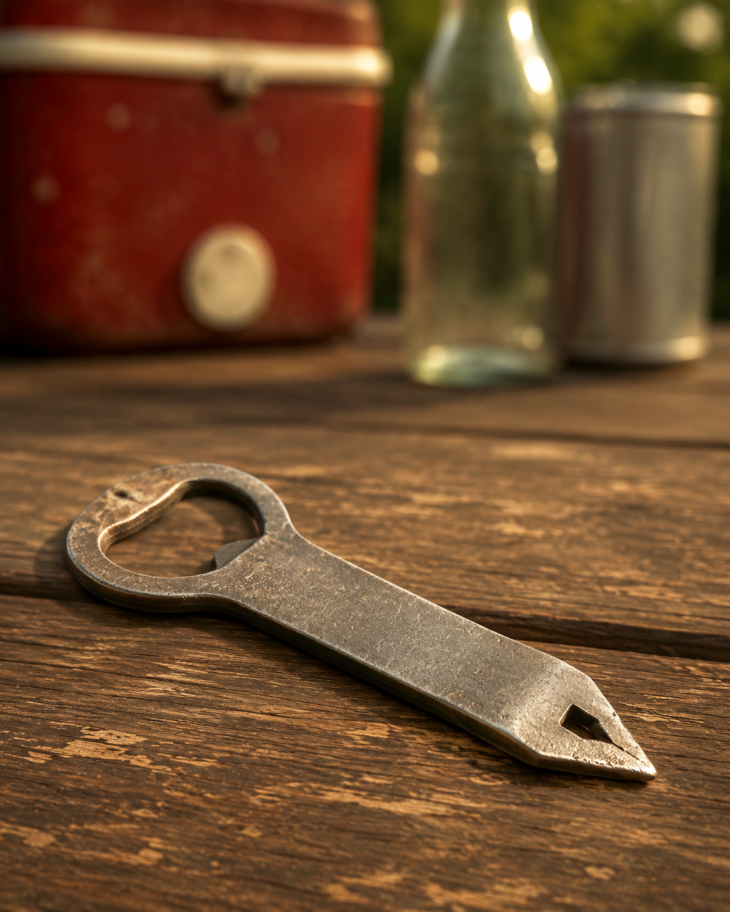
It was flat, slightly rusted and no longer than my index finger. One end was rounded, while the other ended in a sharp triangular point.There were no moving parts and no instructions.My daughter thought it was a miniature gardening tool. My son suggested it might be used for fixing bicycle tires.Dad watched them examine it before asking a simple question.
“How would you open a drink without a pull tab?
”The children looked confused.Dad picked up the tool and explained that it was commonly known as a church-key opener.
One end could lift metal bottle caps. The pointed end was designed to puncture the flat lids of beverage cans from the era before built-in pull tabs became standard.To open a can, a person pressed the pointed end against the lid and pulled upward, creating a triangular hole. A second, smaller hole was usually made on the opposite side to let air enter so the drink could pour smoothly.It was simple, effective—and very different from opening a modern can.Dad remembered when nearly every kitchen drawer, picnic basket and car glove compartment contained one. Soda, beer and other canned drinks sometimes required a separate opener, and forgetting it could leave everyone staring helplessly at sealed cans.Nobody knows with complete certainty how the opener received its unusual nickname. One popular explanation is that its shape reminded people of the large keys once used to unlock church doors.Whatever the origin, “church key” became the familiar name for several styles of bottle and can openers.
Dad’s opener had traveled with him for decades.He carried it to family picnics, fishing trips and summer barbecues. The scratches across its surface came from years of bottle caps, cans and loose tools rattling together.He recalled one camping trip when his friend forgot the opener. They tried using a pocketknife, then a screwdriver, before Dad discovered the church key in the bottom of his backpack.“For the rest of the weekend,” he said, “that little tool was the most valuable thing we owned.”Pull-tab cans eventually made the pointed opener unnecessary, although bottle-opening versions remained useful. Millions of church keys were forgotten in drawers or left inside old toolboxes.
To younger generations, they now resemble mysterious pieces of metal with no obvious purpose.
Dad handed the opener to my son and showed him how the bottle-cap end worked. His expression changed immediately.“So this was the old-fashioned version of a pull tab?”“Exactly,” Dad replied. “Except you had to remember to bring it.
”We returned the church key to the toolbox. It may never puncture another can, but we decided it belonged there.Sometimes the smallest tools unlock the clearest memories.This is a fictionalized story inspired by the history and traditional use of church-key bottle and can openers.





Leave a Reply