Part 2
The radio crackled like static from another world.
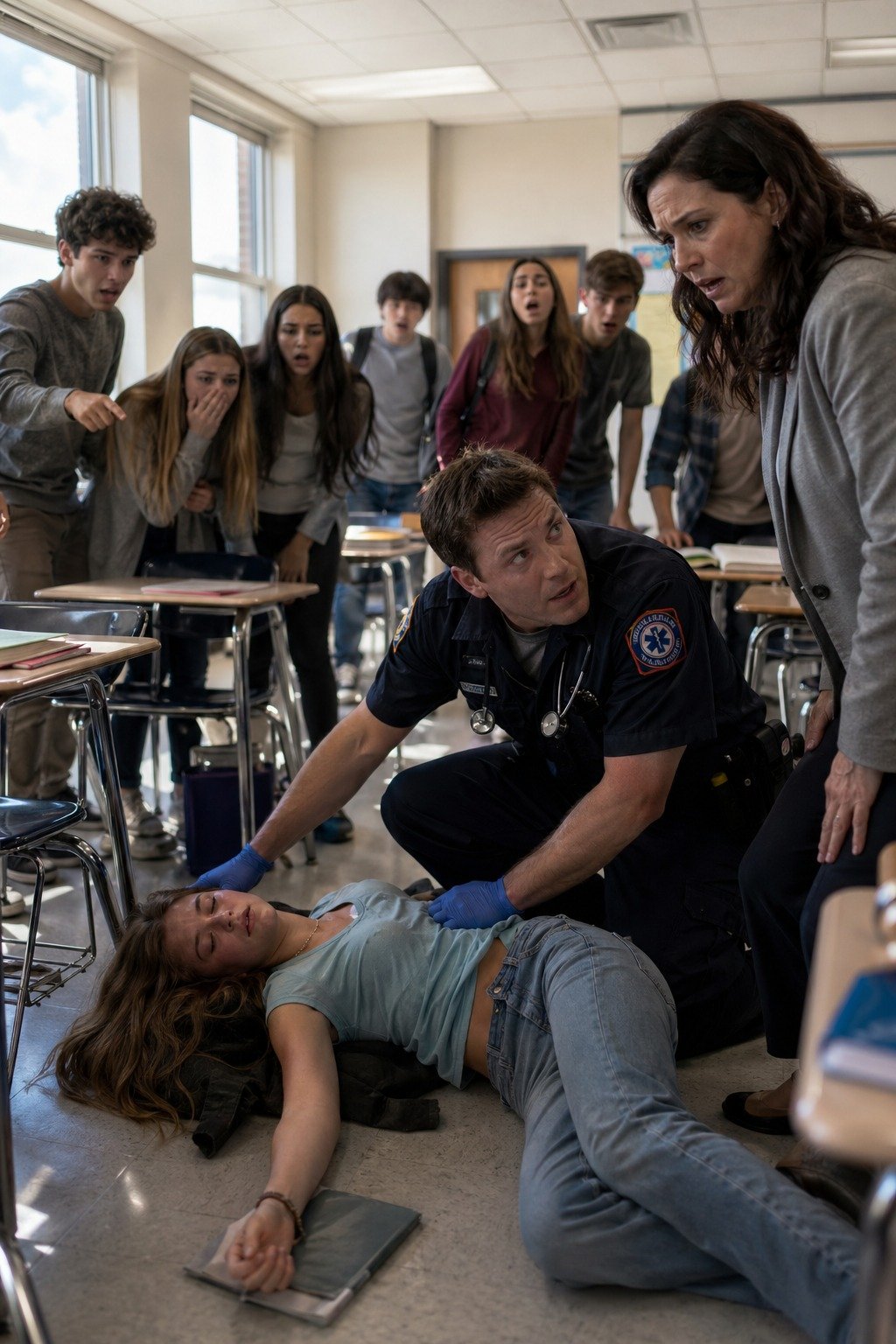
“Unresponsive minor,” the paramedic said. “Irregular pulse. Possible cardiac involvement.”
Cardiac.
The word floated above me, too large to belong in a classroom with faded posters of presidents and a stack of missing homework slips clipped to the board.
Someone gasped.
Ms. Drennick said, “That’s not possible.”
I wanted to laugh, which was insane because I could barely breathe.
Not possible.
That was how adults talked when reality misbehaved in front of them. As if the body had to follow school policy. As if my heart needed permission to fail.
The paramedic ignored her.
Another responder came in, younger, with close-cropped hair and a silver watch that flashed under the lights. He crouched beside me and opened a black kit. I heard plastic tearing, Velcro ripping, the fast click of equipment being assembled.
“She reported symptoms?” he asked.
“She said she was dizzy,” the first paramedic replied.
“She says that all the time,” Ms. Drennick cut in.
A beat passed.
The younger paramedic looked at her. Not rudely. Not dramatically. Just looked.
Then he said, “That usually means someone should ask why.”
The room swallowed that sentence whole.
My chest tightened again, and this time it brought pain with it, a hot wire pulling from the center of me toward my left shoulder. My vision blinked dark at the edges.
The first paramedic noticed something.
“Pulse is dropping.”
“Dropping?” Ms. Drennick repeated.
She sounded different now. Less like a teacher. More like someone who had walked into the wrong room and found her name written on the wall.
A clip went onto my finger. A cuff wrapped around my arm. The pressure squeezed and released. Squeezed and released. The machine beeped, but not evenly. It stuttered.
Brandon muttered, “Oh my God.”
Nobody laughed at him.
I wanted to turn my head and look at Lysa. I wanted to thank her for saying something. I wanted to ask why one person speaking up felt bigger than all the people who had watched me fall.
Instead, I lay there while adults moved around me and my classmates learned, one by one, that a person could be wrong about someone and still have to watch what happened next.
“When did she ask to leave?” the second paramedic asked.
“About ten minutes before she collapsed,” Lysa said.
Ms. Drennick snapped, “You don’t know exactly.”
“I looked at the clock,” Lysa said.
That surprised me.
Even through the fog, that detail landed. She had looked at the clock. Why? Because she was annoyed? Because she was worried? Because she had seen something the rest of them hadn’t?
The first paramedic said, “What happened when she asked?”
No one answered.
That silence was different from the others. It had weight. It had memory.
I remembered it perfectly.
The chalky taste in my mouth. The heat behind my eyes. My own voice sounding thin when I said, “Please, I really don’t feel right.”
And Ms. Drennick saying, “Sit down. You’re disrupting class.”
Now the room remembered too.
“She told her no,” someone said.
It was Evan, I thought. He sat near the windows and never spoke unless called on.
Then another voice. “She said Virelle was being dramatic.”
“I didn’t say it like that,” Ms. Drennick said quickly.
There was a rustle behind me. Phones. I knew the sound because I had heard it a thousand times in hallways and cafeterias. Screens waking up. Cameras opening. Teenagers recording what adults hoped would disappear.
The first paramedic’s tone sharpened.
“I’m calling this in as delayed response from supervising adult.”
That did something to Ms. Drennick.
Part 3
I could not see her clearly, but I saw her shoes stop moving. I heard the tiny inhale she tried to hide.
“Delayed response?” she said. “No. Absolutely not.”
The second paramedic placed an oxygen mask over my face. Cool air rushed in, smelling faintly of plastic and rubber. It helped, but not enough.
“She has unstable vitals,” he said. “We are not debating terminology.”
“I made a professional judgment.”
“Then it will be documented.”
Documented.
That word changed the room more than cardiac had.
Cardiac was about me.
Documented was about her.
The first paramedic leaned close again. “Virelle, can you hear me?”
I screamed yes in my head.
“Blink if you can.”
The light above me split in two. I fought for one tiny movement, one proof of myself. My eyelids trembled. Maybe they closed. Maybe they didn’t. I felt trapped inside my own skin, like I was banging on a locked window from underwater.
“She blinked,” Lysa said.
The first paramedic said, “Good. Good, Virelle. Stay with us.”
For a second, warmth moved through me. Not relief, exactly. More like grief. Because being believed should not have felt like being rescued from a burning house.
They prepared to move me.
The stretcher wheels rattled into the room, too loud against the tile. Desks had to be shoved aside. Someone knocked over a pencil case, and pens rolled across the floor like tiny bones. The smell of vanilla lotion passed near me.
Lysa.
“She told the truth,” she said.
I didn’t know if she meant me or herself.
Hands slid under me. My body shifted, and pain burst white behind my eyes. The monitor gave a frantic uneven beep.
“Careful,” the second paramedic said.
“I am,” the first answered.
Then, quietly, so quietly I almost missed it, Ms. Drennick said, “She can’t be that sick.”
The first paramedic looked at her.
His voice was calm.
“That’s what you already decided. That’s the problem.”
They lifted me.
As the ceiling tilted and the whole classroom spun slowly away, I saw Ms. Drennick’s face for the first time since I fell. Her lips were parted. Her skin looked gray under the fluorescent lights. But it was her eyes I remembered.
Not scared for me.
Scared of what I had become.





Leave a Reply