The Right Part First
The second call cut through the porch silence so sharply that even Martha looked down at my phone.
Unknown number.
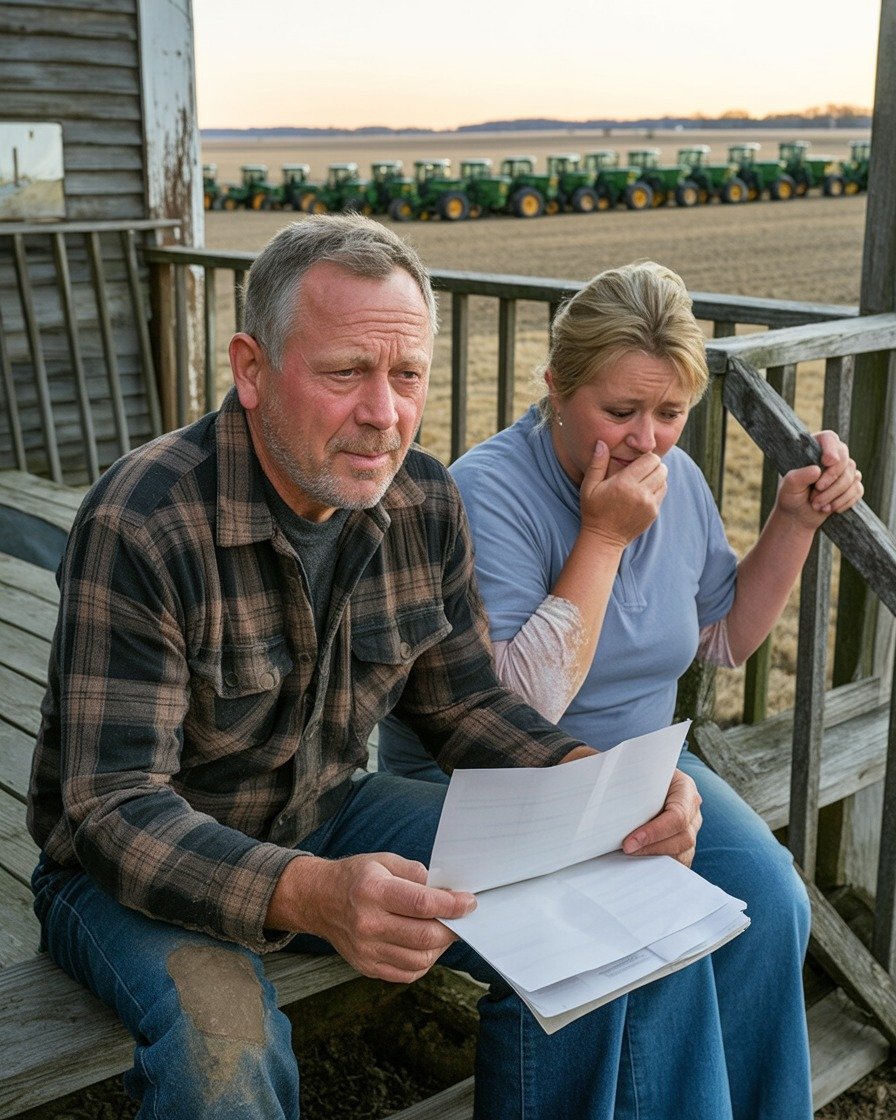
Thomas Wernan was still on the other line, faint and tinny in my right ear. The wind moved over the south field with a dry whisper, and a hundred new windshields flashed under the late-morning sun like a row of mirrors pointed at God. One hundred tractors, still bearing dealer stickers and company plates, parked across my acreage as if the earth had simply decided to produce them overnight.
“Mr. Cooper?” Thomas said. “Are you still there?”
I swallowed, stared at the screen, and switched calls.
“Hello?”
For a second, all I heard was breathing. Slow. Controlled. The deliberate breathing of someone managing effort.
Then the voice came.
“You still keep your coffee too long.”
Every small hair on my arms lifted.
I turned and looked at the cold mug sitting on the porch rail, the dark ring it had made in the peeling white paint, the foreclosure papers bent against my boot, Martha’s hand frozen halfway to her mouth.
“Who is this?” I asked.
The man on the other end let out a breath that sounded almost like a laugh, but there was something rough underneath it. Not mockery. Memory.
“Somebody who owed you forty-two years,” he said.
Martha pressed closer beside me on the step. Flour was still visible at the cuff of her diner uniform. The smell of grease from her morning shift mixed with burnt coffee, diesel haze, and the cut-grass scent drifting in from the south field.
“Where are you?” I said.
“Not far enough,” he answered. “But close enough to hear the trucks made it on time.”
I stood so fast the porch board creaked under my heel. “You sent them?”
Another pause.
Then, quiet and flat: “I sent what I could while I’m still alive to do it myself.”
Something in the way he said alive made my grip tighten around the phone. I walked to the edge of the porch and looked down the long gravel drive, half expecting another truck to appear, or some stranger stepping out of the heat shimmer near the road. Nothing moved except dust settling over tire grooves.
“Tell me your name,” I said.
“Not yet.”
“Why not?”
“Because if I say it too early, you’ll remember the worst part first. I need you to remember the right part.”
Martha’s fingers touched the back of my elbow. They were cool from the outside air, but trembling.
Forty-two years earlier would have been 1982. The year after Dad let me take over more of the books. The year Martha and I were newly married and so broke we used a milk crate as a nightstand. The year half my memories were mud, unpaid fuel bills, and trying not to let my father see how scared I was. We were running two hundred acres of corn and soybeans with equipment that was older than my marriage and temperamental as a sick horse, and there were weeks that spring when I drove to the mailbox and drove back without opening it because I couldn’t face whatever was inside.
That was the year I learned the particular quality of fear that comes from farming, which is different from other fears because the threat is never abstract. The land is real and the debt on it is real and the weather is indifferent and the margins are thin enough that one bad season can begin a slide that takes three or four good years to stop. My father had grown up in the Depression and had a farmer’s fatalism about the whole enterprise, which was less despair than practical adaptation, the understanding that you could do everything right and still lose what you’d worked for, and that the only sensible response was to keep working. He had passed that philosophy to me along with the land, and I was trying to live by it in 1982, but some days the philosophy and the bank balance were in direct conflict.
The foreclosure notice that had arrived seventeen days ago was not, in that sense, a surprise. It was the destination of a road I had been on for two years. A drought, then a machinery failure that cost forty thousand I didn’t have, then an interest rate that moved when I had assumed it was fixed. I had talked to the bank four times. I had talked to a lawyer once. I had talked to Martha every night in the kitchen after dinner, over coffee I kept too long because I was distracted and she understood. We had not talked about what happened if we lost the farm, because we had both grown up in this county and we both knew what that looked like, and neither of us was ready to say it plainly yet.
The tractors had appeared this morning before I was dressed. I had come out onto the porch with my coffee and watched the first truck turn in from the county road, and then another behind it, and then another, until there were seven trucks and the field was filling with machines so new they still had factory film on the cab windows. I had called the bank immediately, thinking there was some mistake, some equipment-financing situation I hadn’t been told about. Thomas Wernan had not known what to tell me.
“Tell me your name,” I said.
“Not yet.”
“Why not?”
“Because if I say it too early, you’ll remember the worst part first. I need you to remember the right part.”
The man didn’t answer immediately. In the distance, a metal panel on the equipment shed knocked once in the wind. From the field came the hot smell of rubber and factory oil warming under the sun.
“There was a bus station in Paducah,” he said at last. “December. Snow pushed up black against the curb. I had one denim jacket, one split lip, and twenty-three dollars stitched inside my boot because I thought somebody might steal it while I slept.”
My chest tightened.
I could see flashes, but not a face. A winter bus station. Steam from coffee. Dirty tile. A kid sitting too straight because if he slouched, he’d fall asleep.
“You came in for change,” the man continued. “You bought a sandwich. Ham on white bread. You looked at me twice. Most people only looked once.”
Martha’s nails dug lightly into my sleeve.
Then it hit. Not all at once. In pieces.
A boy. Maybe twenty-one or twenty-two. Dark hair too long over his collar. One cheek purpled yellow from an old beating. Boots that were falling apart at the seam. The kind of hunger that wasn’t loud because it had gone on too long to ask. I had gone to Paducah for a used combine part with my father and come back alone because Dad had stayed behind with a supplier. It was a Tuesday. Cold enough that the windows in the bus station ran with condensation.
The kid had watched the food in my hand with the stillness of an animal that had been kicked for moving too fast.
“Tommy,” I said before I knew I knew it.
The line went silent.
Then the man let out one shuddering exhale.
“Nobody’s called me that in thirty years,” he said.
My knees went weak enough that I sat back down on the porch step.
Tommy Reed.
He had come to the farm with me that Tuesday evening, because I had bought him a second sandwich and asked if he needed a place to sleep for a night, and he had looked at me for a long moment the way people look when they’re calculating whether kindness has a cost. Then he had picked up his bag and followed me to the truck without another word. He said he was heading north for work, then west, then maybe nowhere. He never gave me much more than that. People who had been hurt young learned to protect details like they were money.
But I remembered the rest now because memory, once unlocked, does not return politely.
I remembered his hands shaking when Martha set down a plate of eggs and biscuits his first morning. I remembered him flinching when my father clapped him on the shoulder in greeting, the automatic flinch of someone who had learned that sudden contact from men usually meant something bad. I remembered seeing the marks under his sleeve when he reached for the coffee mug, the kind of marks that left no ambiguity about what had happened, and I remembered making a decision in that moment not to ask questions he wasn’t ready to answer.
He had been with us maybe two days when the morning came that I had not fully let myself remember until now.
Dad had put Tommy on the north fence line with me because a post had split after a hard freeze. The ground was iron. Our breath came out white. My gloves were soaked through by eight in the morning. Tommy worked like somebody trying to outrun his own life, that particular quality of labor people apply when standing still feels dangerous. He moved quietly and efficiently and didn’t waste words, and I had been starting to think we might keep him on for the rest of the season if he wanted.
Around noon, a black car turned onto our lane.
I remembered it now. The shine of it against the gray mud of our road, too clean, too deliberate. Two men got out wearing city coats and the expressions of people who arrived places to take things. Not law enforcement. Something else. The kind of men who didn’t need badges because their authority came from a different source.
Tommy went white as flour.
“Inside,” he told me.
“Who are they?”
“Not friends.”
He had tried to walk toward the barn, calm but too fast, and one of the men grabbed him by the collar before he made three steps. Dad heard the shouting and came out of the machine shed with a wrench in his hand. Martha heard it from the kitchen. I was twenty-one and angry in the way young men are angry when they haven’t yet learned that anger without strategy just gets people hurt.
One of the men said Tommy had stolen from the wrong people in St. Louis. The other smiled while he said that a boy like that should be grateful if he got to keep both knees. It had sounded rehearsed, the kind of threat that had been delivered before in other driveways, practiced to sound casual.
Dad stood between them and Tommy and said, “You can explain yourselves to the sheriff, or you can get off my land while your tires still hold air.”
The smiling one took a step toward him.
I had never seen my father change expression the way he did in that moment. Calm. Flat. Certain. He lifted the wrench one inch and said, “Try it.” No volume. No theater. Just the particular stillness of a man who meant what he said and had nothing to prove about it.
The men looked at me, then at the house where Martha was already on the phone inside, then at Dad. Men like that preferred easy fear. Farms with witnesses and armed Midwesterners on the porch were not easy fear.
They left gravel spinning behind them.
Tommy lasted another twenty minutes before his legs gave out beside the feed room.
He had a fever. Bruised ribs. A gash at the side of his scalp that had half-healed under dirt, probably from whatever had happened before the bus station in Paducah. We got Doc Hanley out from town after dark and paid cash because Tommy didn’t want his name anywhere official. He stayed in our upstairs room for three weeks. Martha brought soup every day without being asked. Dad never once mentioned repayment, not directly and not by implication. I gave Tommy work when he could stand. Mucking stalls. Sorting bolts in the machine shed. Cleaning tools. He learned everything fast because learning had always been survival for him.
He left on a Tuesday in January, early enough that the frost was still on the windshields. I gave him the bus fare to Louisville and my father’s old work jacket and tried to give him more money than he would take. He shook my hand at the end of the drive and said he’d write when he was somewhere stable. He never did, and after a year I had stopped checking the mailbox for his name.
On the phone, the man’s voice had gone softer.
“I stole that money,” he said. “Not from those men. From the safe of the man they worked for. He was running trafficking through his trucking business. Kids mostly. Half runaways, half boys nobody was looking for hard enough. I was one of them before I got out. I took his ledger and his cash because I thought if I ran far enough, I could make him bleed even if I couldn’t stop him.”
I closed my eyes. The porch smelled of sun-baked wood, diesel, and the old coffee gone cold on the rail.
“Tommy.”
“You didn’t know,” he said. “I made sure you didn’t know. If you had, you’d have called the law, and maybe that would’ve been right. But I was too scared to trust anybody in a uniform back then. What you and your father did instead kept me alive long enough to hand that ledger to the FBI six months later in Louisville.”
Martha sank slowly onto the step beside me.
“The FBI?” she whispered.
I put the phone on speaker.
“The case disappeared from the papers inside a week,” Tommy said. “Big men, bigger money. But it didn’t disappear for me. Federal witness program for a while. Community college under another name. Then trucking. Then freight software. Then logistics hubs. Then acquisitions. A few lucky years. A few brutal ones. I got mean in some places, smart in others, and old before I planned to. But every time I signed a contract worth anything, I remembered your father handing me work gloves and saying, ‘If you’re sleeping under this roof, you work, eat, and keep walking forward.’”
Martha covered her mouth, not to stop a gasp this time, but to hold herself together.
“Heartland,” I said, thinking of the jacket on the first driver, the company name across the back.
He laughed once. “One part of it. I kept the old name from the second company I bought because I liked the sound. Made me think of roads I’d survived.”
I looked over the field again. A hundred tractors, each one worth more than what I owed the bank, sitting in my south field like proof that time had curved back around on itself.
“You should have come yourself,” I said.
There was the briefest pause.
Then: “I tried.”
That was when I heard it. Not memory. Present. A machine beeped in the background of his call. Then another. The sound of a hospital monitor. I knew it from when Martha had her gallbladder out, from when Dad died, from too many waiting rooms with too much bleach in the air.
Martha heard it too. Her eyes snapped to mine.
“Where are you really?” I asked.
Tommy breathed in slowly, then out. “St. Mary’s in Evansville. Oncology floor. I had the tractors purchased, insured, and routed before my second round started. I wasn’t willing to gamble on another spring.”
The words landed quietly. Harder for that.
The wind lifted one corner of the foreclosure packet and slapped it back against the porch boards.
“How bad?” I asked.
“Bad enough to stop postponing things. Good enough that I can still travel if I have a reason.”
I stared at the field, at the rows of bright machines still too new to look entirely real against my worn barns.
“Then I’m coming today,” I said.
He exhaled, and for the first time since he had called, his voice cracked. “I was hoping you would.”
By noon, the farm had turned into a rumor that moved faster than either of us. Harold was still there when his wife arrived, and two men from the co-op pulled up in a dusty Silverado and sat in stunned silence at the gate before walking over to look. Somebody posted a photograph from the road. By twenty minutes past noon, Daniel Cooper and the tractors had made it to three county Facebook pages and one Chicago farm-equipment account that got half the facts wrong but the number right.
At ten past one, Thomas Wernan himself drove up in a navy sedan with his tie still on. He walked to the foot of the porch with a leather folder pressed to his side and the expression of a man who had decided that bearing witness was more important than maintaining professional distance.
“Mr. Cooper,” he said. “I thought it best to discuss this in person.”
I did not ask him to sit.
The sun had warmed the porch boards. Somewhere down by the field, a meadowlark was calling from the fence line. Martha handed me a glass of sweet tea so cold it sweated against my palm.
“Discuss what?” I asked.
Thomas adjusted his glasses. “Your account was paid at 11:22 this morning by certified wire. Full balance. Fees included. In addition, a separate deposit was made into a new operating account opened in your name at our main branch.”
“How much?” Martha asked.
He cleared his throat. “One million dollars.”
Harold, standing behind him in the yard, said “Sweet Jesus” so quietly it almost sounded like a prayer.
Thomas opened the folder and extended a packet toward me. “The lien is released. Effective immediately. The foreclosure is canceled. This paperwork records satisfaction in full.”
For seventeen days, that institution had been a countdown clock in my chest. Now it was just paper again.
“Who sent the wire?” I asked, though I already knew.
Thomas hesitated a moment, the hesitation of a man deciding between the rule and the story. “The transfer came from Reed Logistics Holdings,” he said at last.
Harold looked from the tractors to me to the folder and said, “Daniel, who on earth did you help?”
Before I could answer, a black SUV turned into the driveway and came slowly toward the house. Not flashy. Not new. Quiet engine. A hospital parking tag visible in the windshield.
It stopped near the porch.
The driver got out first, a woman in her fifties wearing navy scrubs under a cardigan, and moved around to the passenger side with the practiced care of someone who did this work daily. The man who stepped out was tall, thinner than memory, carrying more years in his face than his age should have required. I had imagined this moment a hundred times in different versions over the years, in the earlier years when I still wondered what had happened to him, and the face I had imagined was always the young one, the battered boy from that winter, the one I had last seen at the end of the drive in my father’s old work jacket with a bus ticket in his hand.
This was not that face. This face had been carved by time and work and something else, the particular way illness changes a person from the inside, the skin going slightly translucent, the features sharpening, the eyes becoming more prominent because the rest of the face has pulled inward. But the angle of his jaw was the same. The way he held himself when he straightened, careful and deliberate, was the same. And when he looked up at the porch, the expression was the same one he had worn the first morning at our kitchen table, the wariness of a man who was accustomed to gifts being retracted.
His hand pressed once against his ribs when he stood fully upright, then fell to his side.
Tommy Reed looked at the porch like he wasn’t sure it was still real.
Neither was I.
I went down the steps faster than my knee liked, the old injury from a fence post incident fifteen years ago making itself known the way it always did when I moved in a hurry. The gravel shifted under my boots. Up close, I could see hospital tape bruising the inside of his wrist where an IV line had been removed, and the careful way he was managing his breathing, not labored, just conscious, the way you breathe when you have learned that some breaths cost more than others.
“You kept the porch,” he said.
“You kept breathing,” I answered.
That broke something in both of us. He laughed once, the sound rusty and surprised, and covered his eyes with his hand for a moment. When he lowered it, there was wetness at the corners.
Then he held out his arm, and I stepped into it.
It was not a dramatic embrace. Two old men in work clothes and road shoes, gripping each other’s shoulders in a gravel driveway while a banker, a waitress, a neighbor, and a field full of twelve million dollars watched. His back felt too sharp under my hand. Mine probably did too.
“I never thanked your father,” Tommy said into my shoulder.
“He knew,” I said.
He pulled back and looked toward the house. Martha was crying openly, one hand pressed flat against her chest. She came down the steps, and Tommy’s whole face changed when he saw her. Something boyish moved across his features for a second.
“You made biscuits,” he said. “And tomato soup from the can, but with black pepper like it was expensive.”
Martha laughed through her tears. “You ate six in one sitting.”
“I was making up for lost time,” he said.
The oncology nurse gave him five quiet minutes before touching his elbow and saying, “Mr. Reed, you need to sit soon.” So we brought chairs into the shade of the porch. Thomas Wernan remained, because he had clearly decided a story like this was worth staying for. Harold stayed because Harold would rather miss his own funeral than a moment like this.
Tommy signed two more forms from his leather folio. Not for the gift. That was done. These were for the rest.
He had set up a maintenance trust for the tractors with three years prepaid. He had hired a tax attorney in Springfield to structure the transfer so the government wouldn’t take a significant portion back out of gratitude. He had arranged a long-term leaseback option with two neighboring farms so that if I chose to sell or rent part of the fleet, I could generate enough operating income to keep the land, repair the barns, and still retire without panic.
Organized mercy. Not loud. Not sloppy. Complete. The scared young man had become the kind of man who solved problems all the way down.
At one point, looking out over the rows of tractors, he said, “I almost sent money. But money gets swallowed. I wanted to send something no banker could misunderstand.”
Thomas, to his credit, said nothing.
By late afternoon, the spring light had softened to gold along the edges of everything. The tractors in the south field no longer looked unreal against my worn barns. They looked claimed.
Tommy stood carefully, the nurse close enough to catch him if he needed it. He reached inside his jacket and pulled out one final envelope and handed it to me.
“Open it after I leave,” he said.
“Why?”
A tired smile moved one corner of his mouth. “Because I know you. If you open it now, you’ll argue.”
He hugged Martha. He shook Harold’s hand with both of his. He nodded once to Thomas, who received it like a man being admitted to a private order of witnesses. Then Tommy got back into the SUV. I stood in the driveway and watched until the vehicle disappeared past the mailbox and the dust settled slowly back over the road.
Only then did I open the envelope.
Inside was a folded deed copy, a cashier’s check made out to Martha Cooper for sixty-three thousand dollars, and a short note in careful handwriting.
For the diner shifts she should never have had to work this hard.
Below that was the address of a children’s transit shelter in Louisville funded by something called the Reed Foundation. In small print under the letterhead, almost like an afterthought, were the words: Dad Cooper House.
Martha touched the page with two fingers and didn’t say anything for a long time.
The porch was quiet except for the evening insects starting up in the grass and the soft tick of cooling metal from the field.
My father had died eleven years ago, in the same hospital where Tommy was now being treated. He had farmed this land for fifty years without ever calling himself a good man, because he was the kind of person who thought that claiming goodness made it worth less somehow, diluted it. He fixed what was broken, fed what was hungry, and stood between harm and the things in his care with the particular certainty of someone who had never needed to think about whether it was the right thing to do. He stood between those men and Tommy without a moment of calculation, with a wrench and a flat expression and a single sentence, and then he went back to the machine shed and finished what he had been doing, because in his view the matter was resolved and there was work left in the afternoon.
He had never spoken of Tommy to me after that winter. Not to ask where he had gone, not to wonder how he turned out, not to draw any lesson from it. The kindness was not a story he told. It was simply something that had happened and that was, in his estimation, the correct thing to have happened. I had inherited his land and his equipment and his approach to fixing fence posts and his slightly reckless generosity toward strangers on cold Tuesdays, and I had spent forty-two years not understanding the full weight of what that generosity had set in motion.
Somebody had been keeping score all along. Somebody who had been keeping it for forty-two years, with interest.
As the sun dropped, the rows of tractors threw long shadows across the south acres that my father used to walk at this hour, checking the field with his hands behind his back and the slow deliberate gait of a man taking inventory of something he was responsible for. He used to say this ground would outlast all of us if we respected it enough.
That night, for the first time in months, I carried no foreclosure papers inside.
Only the notes.
I set them on the kitchen table where my father used to sit for his morning coffee, under the window that looked out over the south field. Martha poured me a cup I wouldn’t drink while it was hot, because I never did, and sat down across from me without saying anything that needed saying.
Outside, the last of the light was going, and in the distance, those hundred machines stood still and solid in the dark, waiting for morning the way good tools always wait, patient and useful and absolutely present, already belonging to the land the way everything eventually does if you treat it right.



Leave a Reply