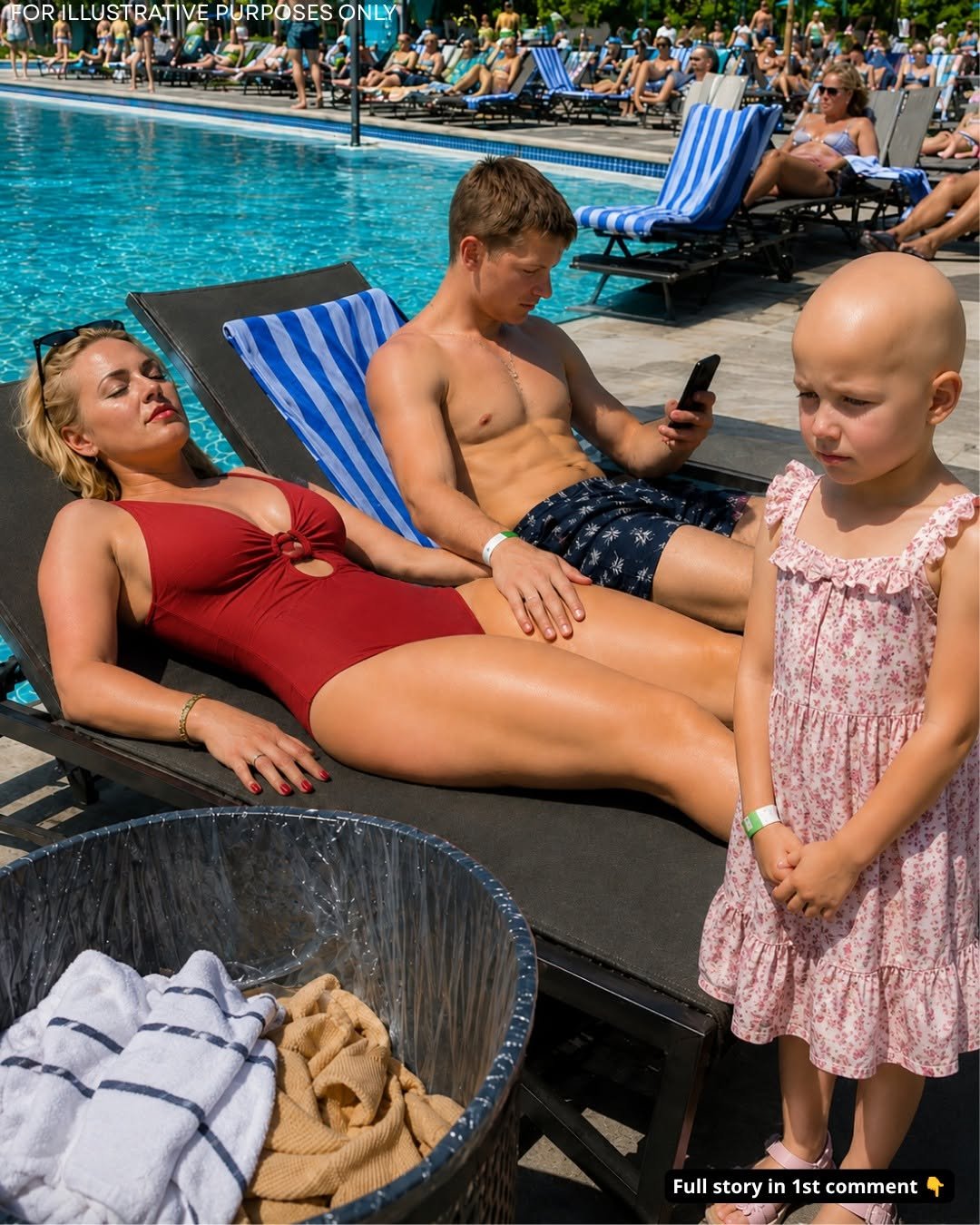
After completing her final chemotherapy treatment, my daughter wanted only one thing: a peaceful day by the pool. I reserved two lounge chairs, secured our towels with clips, and stepped away to grab smoothies. When we returned, a stranger had taken our spots, our towels had been tossed into the trash, and her heartless remarks nearly destroyed the first truly happy day Mia had experienced in months.
Mia had finished her final chemo session eleven days before our resort getaway.
Not the kind of ending where everyone applauds and life immediately returns to normal. The kind where a doctor offers a cautious smile and says, “We’re done for now,” because everyone understands that hope has become careful with its words.
But Mia focused on the part that mattered.
Done.
Eleven days before the trip, she sat on the exam table with her thin legs swinging beneath the paper gown. One hand rested over the hospital bracelet she still wouldn’t remove.
“Can we go somewhere with a pool, Mom?” she asked.
I stared at her.
“A pool?”
“Yes. Like a regular kid.”
That same afternoon, I booked the resort.
Only an hour away, yet to Mia it felt as distant and magical as Hawaii.
She packed three swimsuits she’d never had the chance to wear, her pink goggles, a paperback book she would never open, and the stuffed dolphin a nurse had given her during treatment.
When we checked in, the front desk employee handed us towel clips marked with our room number.
“Just clip your towels to the reserved chairs overnight or before breakfast,” she explained. “The pool gets crowded fast.”
I thanked her.
Then apologized when Mia dropped her goggles.
Then apologized again when my card failed to scan.
The clerk offered a warm smile.
“No trouble at all.”
I hardly processed her response.
That year had changed me. Hospitals, insurance paperwork, school messages, endless waiting rooms.
At some point, I had developed the habit of apologizing before asking for anything, as though needing assistance automatically inconvenienced everyone around me.
I had started apologizing before asking for anything.
The next morning, Mia was awake before dawn.
Her swimsuit hung loosely on her small body, but she stood before the mirror smiling proudly.
“Do I look like a pool girl?”
“You look like the pool might not survive you, sweetheart.”
She laughed, then touched her bracelet.
“Should I take it off?”
“Only if you’re ready.”
She glanced down.
“Mmm, not yet.”
We claimed two ideal lounge chairs beneath a large umbrella near the shallow end. I clipped our towels exactly as instructed, smoothing Mia’s towel twice because she liked things orderly now.
Illness had taken so much control away from her. Whenever possible, I tried to return some of it.
For thirty minutes she floated happily in the water, giggling every time a splash reached her face.
“I love it here, Mom,” she said, her voice overflowing with happiness.
Behind my sunglasses, I nearly cried.
Then she requested smoothies.
“We’ll be quick,” I assured her—and myself.
We were gone roughly fifteen minutes.
Maybe even less.
When we returned, someone else occupied our chairs.
A woman in a white designer swimsuit lounged across mine, her sunglasses resting atop perfectly styled hair. A man, presumably her boyfriend, sat in Mia’s chair scrolling through his phone as though he owned the place.
Our towels sat crumpled in a nearby trash can.
I froze.
Mia tightened her grip on her smoothie.
“Mom? That’s… our spot.”
“I know, baby. Let me handle this.”
I approached them.
“Excuse me,” I said carefully. “Those were our reserved chairs.”
The woman didn’t bother looking up.
“Reserved doesn’t mean anything if you’re not sitting in them.”
“We were gone for 10 minutes.”
“Not my problem!”
Her boyfriend smirked without even lifting his eyes.
I pointed toward the towel clips still attached to the side table, our room number clearly visible.
“Those tags are ours.”
Only then did she look at me.
Then at Mia.
Her eyes traveled over my daughter’s bald head, thin shoulders, and the hospital bracelet around her wrist.
“Those tags are ours.”
A sneer appeared.
“Honestly, maybe go somewhere a little more appropriate.”
Everything around me seemed to stop.
The splashing water.
The music.
The sounds from the bar.
All I heard was Mia catching her breath.
A year’s worth of fear surged through me so suddenly I thought I might fall apart.
But Mia was standing beside me.
She had already spent too many months listening to adults whisper about her.
So I reached into the trash, retrieved our towels, and stayed silent.
A lifeguard near the entrance witnessed everything.
So did a resort employee wearing a polo shirt beside the towel station.
He met my gaze.
I looked away first.
We settled into two ordinary chairs near the back fence. One had a broken strap, and the other sat mostly in direct sunlight. Mia carefully sat down, leaving her smoothie untouched.
“Maybe the chairs weren’t really ours,” she whispered.
I knelt before her.
“They were ours.”
She glanced toward the woman, who was laughing at something on her boyfriend’s phone.
“Then why didn’t she give them back?”
I didn’t have an answer that wouldn’t take even more from her day.
So I forced a smile.
“Because some people forget rules are for them too, baby.”
She looked down at her bracelet.
I hated seeing that.
About twenty minutes later, the employee in the resort polo walked past carrying a shiny blue gift box.
As he passed, he gave me a subtle wink.
Nothing dramatic.
Just enough to make me pay attention.
He stopped beside the woman.
“Excuse me, Ma’am.”
She pushed her sunglasses up.
“Yes?”
His smile widened.

“Congratulations! You’re actually our 500th guest to check in this week. We have a little gift for you.”
Her face lit up.
“I told you this place had excellent service, Peter!”
Nearby guests began watching.
He handed over the box.
She eagerly opened it.
Inside were VIP wristbands, a cabana upgrade, spa vouchers, a sunset family photo package, and a reservation at the resort’s finest restaurant.
The woman gasped.
“Oh my God!”
Her boyfriend finally looked up.
“That’s crazy.”
She immediately reached for the wristbands.
The employee maintained his pleasant smile.
“Wonderful. May I confirm your room number before I activate those?”
She proudly provided it.
He glanced at his tablet.
Then his expression shifted.
Not vanished.
Shifted.
“I’m afraid these weren’t prepared for your room, Ma’am.”
Her hand stopped mid-motion.
“WHAT?”
A manager stepped forward from beside the towel station. The lifeguard joined him.
The manager remained calm.
“Those gifts were arranged for the guests assigned to these reserved lounge chairs.”
A quiet hush spread around the pool.
The woman’s smile weakened.
“They left.”
The lifeguard answered evenly.
“They were gone less than 15 minutes. Their towels were clipped with room tags, and I watched you remove them.”
Her boyfriend shifted uncomfortably.
The manager glanced toward the trash can.
“Did you happen to notice the room number before throwing their towels away?”
She said nothing.
Because she had.
Everyone knew she had.
The manager gently removed the box from her lap.
“Unfortunately, violating our guest policy means you are no longer eligible for this promotion. We’ll also need these chairs returned to the guests who reserved them.”
Her face drained of color.
“This is ridiculous.”
The manager nodded politely.
“I’m sorry you feel that way.”
Nobody applauded.
Nobody celebrated.
That somehow made it worse.
Only the scrape of chairs, the rustle of fabric, and the unmistakable discomfort of people pretending not to stare while absolutely staring.
The employee carried the blue box over to Mia.
Then crouched to her level.
“Hi, Mia.”
She looked surprised.
“How do you know my name?”
He smiled.
“Your mom mentioned it when she checked in.”
I had.
While apologizing for taking too much time.
“We actually have something that really is yours,” he said.
He handed her a smaller blue box wrapped with silver ribbon.
Mia carefully opened it.
Inside sat a stuffed sea turtle wearing tiny sunglasses, dessert vouchers, a photo session card, and a laminated badge labeled “Pool Hero.”
Beneath everything was a handwritten card.
Mia unfolded it.
“Welcome back to being a kid.”
“Your cannonball made my morning.”
“We saved the shadiest umbrella for you.”
“Strawberry smoothies are better with whipped cream. Come see me.”
“Keep swimming, brave girl.”
I looked up.
The young employee from the smoothie stand waved.
The lifeguard smiled.
A housekeeper discreetly wiped her eyes.
My throat tightened.
The manager stepped beside me.
“I hope you don’t mind me saying something.”
I shook my head.
“You apologized to almost every employee you’ve spoken to since yesterday.”
Warm embarrassment crept across my face.
“You apologized when you asked where the elevator was. You apologized when your daughter dropped her goggles. You apologized when housekeeping held the door.”
His smile was kind.
“I don’t think you’ve done anything that required an apology.”
For a moment, I couldn’t respond.
Because he was right.
I had spent an entire year apologizing my way through survival.
To nurses.
To receptionists.
To teachers.
To insurance representatives.
To strangers in grocery stores whenever Mia needed extra time.
I had become so accustomed to asking permission for my daughter to exist comfortably that I forgot we were allowed to take up space too.
Mia continued reading the card, her lips trembling.
“Mom?”
“Yeah, baby?”
“Can we take one while I still look like this?”
Something broke open inside my chest.
Her bald head.
Her bracelet.
Her fragile arms.
The body that had endured more than any child should ever endure.
I brushed her cheek gently.
“Exactly like this.”
Our original umbrella chairs were returned.
Fresh towels replaced the old ones.
New smoothies arrived topped with whipped cream and tiny paper umbrellas.
Mia hugged the stuffed turtle proudly.
Then she looked at me.
“Mom?”
“Hmm?”
“See? Sometimes people are nice.”
I laughed through tears.
“Yes, honey.”
She grinned.
“Even when other people are gross.”
I nearly spit out my smoothie.
Later that day, the pool area became quieter.
The woman and her boyfriend had vanished to another part of the resort. I never looked for them. For once, their cruelty wasn’t the most important thing happening.
Mia performed three careful cannonballs.
Then five.
Then one so dramatic the lifeguard gave her a thumbs-up.
As sunset approached, a young boy wearing a medical mask stopped near the pool entrance with his mother. He appeared around Mia’s age, perhaps younger. His mother surveyed the crowded seating area with that familiar apologetic expression already forming.
I recognized it instantly.
That silent question:
Are we allowed here?
I raised my hand.
“We’ve got plenty of room.”
The woman blinked.
“Are you sure?”
“Absolutely.”
I spread an extra towel beside us and secured it with one of our room tags.
The relief in her smile looked like someone had offered her far more than a chair.
Mia patted the seat beside her.
“This umbrella is the best one,” she told the boy. “And the slide on the left is faster.”
Within minutes, they were comparing scars like treasured secrets.
I leaned back in my chair, sunlight warming my arms, the blue box safely tucked beneath the table.
That morning, I believed I would have to fight the world just to give Mia one normal day.
By evening, I understood something different.
There were still strangers willing to quietly make room for us.
And for the first time in a very long time, I stopped apologizing for the space we occupied.
I simply sat there and watched my daughter laugh in the pool…
like a regular kid.





Leave a Reply