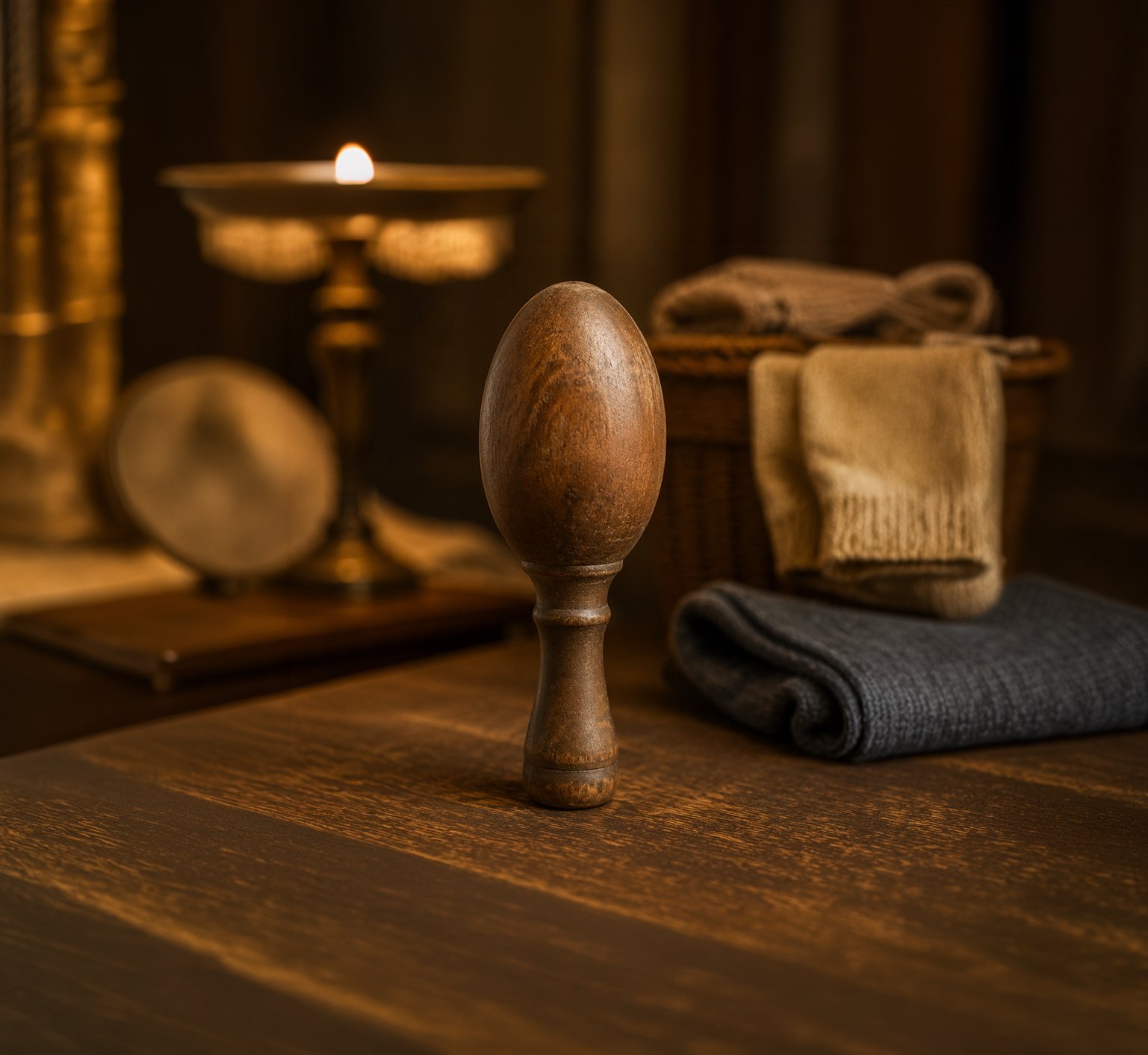
We were clearing out Grandpa’s bedroom when my husband discovered a peculiar wooden object inside the bottom drawer of an old dresser.
It had a smooth, egg-shaped top and a short carved handle. The dark wood had been polished by years of use, although none of us could imagine what it had been used for.
My husband examined it carefully.
“Maybe it was an old-fashioned door handle,” he suggested.
My sister thought it might have been part of a curtain rod. I wondered whether it was some kind of kitchen tool that had somehow ended up in the bedroom.
Each new guess became more ridiculous than the last, and before long, the entire family was laughing.
Then Aunt Margaret entered the room.
She took one look at the wooden object and immediately recognized it.
“That belonged to your grandmother,” she said. “She used it almost every evening.”
Our laughter stopped.
Aunt Margaret explained that the mysterious object was a sock-darning egg. Before inexpensive clothing became widely available, families repaired worn socks instead of throwing them away.
The wooden egg was inserted inside a sock and positioned beneath the hole. Its rounded surface stretched the fabric gently and provided a firm base for sewing.
Using a needle and thread, the person repairing the sock would weave new threads across the damaged area. The process was called darning. When done carefully, it created a strong patch that could extend the life of a sock for months or even years.
Some darning eggs were made from polished wood, while others were produced from stone, porcelain or even glass. Similar tools were shaped like mushrooms and often included handles that made them easier to hold.
Grandma had raised five children during a time when nothing useful was wasted. According to Aunt Margaret, she kept a sewing basket beside her chair and repaired the family’s clothing in the evenings.
Grandpa never learned to darn socks himself, but he watched Grandma do it for more than 40 years.
After she passed away, he placed the wooden egg in his bedroom drawer. He didn’t keep it because he planned to use it. He kept it because the worn wooden surface reminded him of her hands.
Suddenly, the object no longer seemed funny.
The scratches and faded finish weren’t signs of neglect. They were evidence of countless evenings spent caring for a family—one small repair at a time.
We decided not to sell or discard it. Instead, we placed it inside a small display box with one of Grandma’s sewing needles and a photograph of her sitting beside Grandpa.
Today, most damaged socks are quickly replaced. Darning eggs have largely disappeared from ordinary homes, and many younger people have never seen one.
But this simple wooden object reminds us of a different time: a time when possessions were repaired, resources were respected and love was often expressed through quiet, practical work.
This is a fictionalized story inspired by the real history and purpose of traditional sock-darning eggs.





Leave a Reply