The Three Girls in the Park
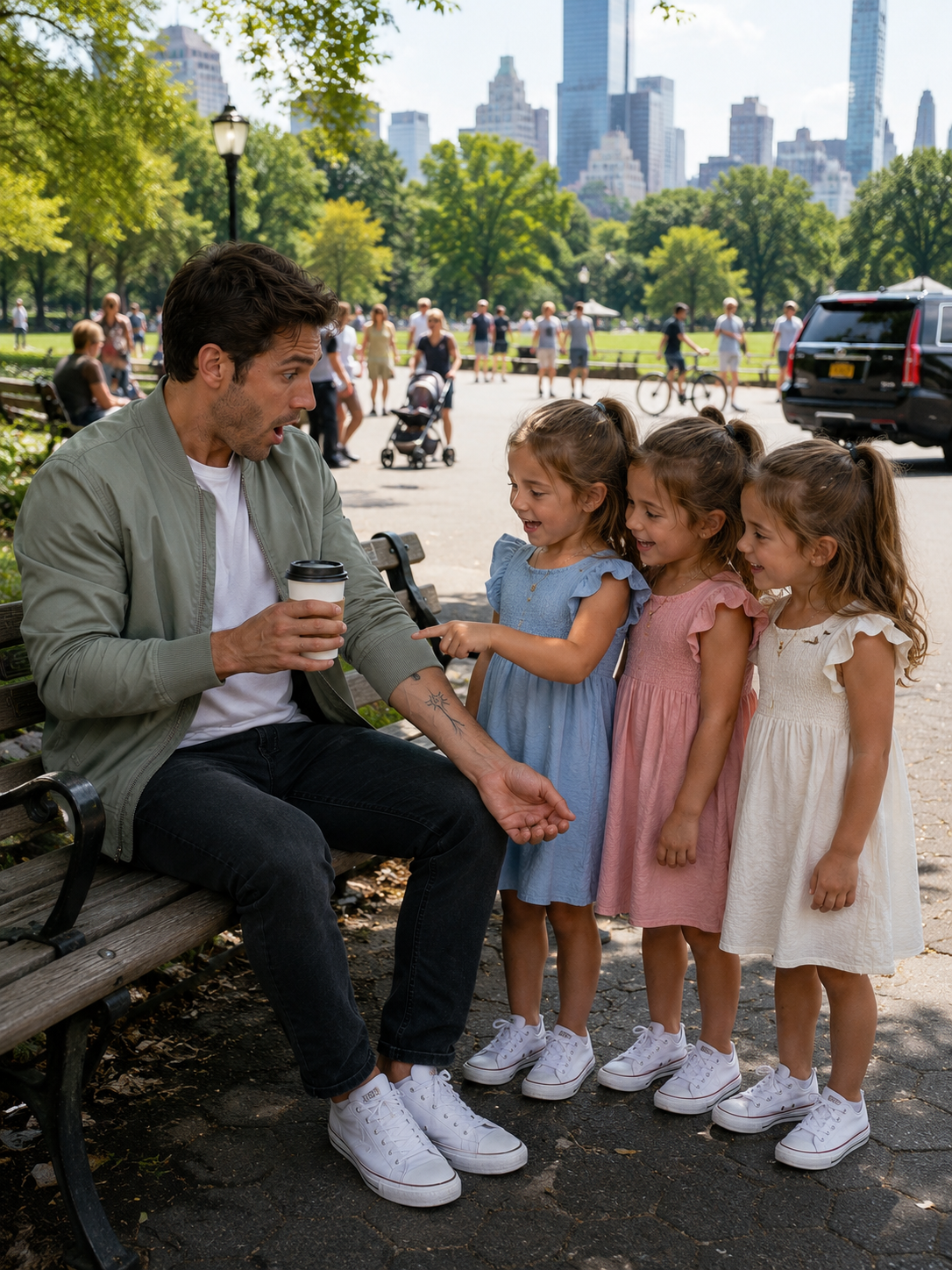
The first time the triplets noticed my tattoo, I was sitting by myself on an old wooden bench beside the lake in Prospect Park, Brooklyn.
It was late in the afternoon, one of those New York afternoons when the sun dipped low through the trees and made everything seem gentler than it actually was. I had just wrapped up a long day repairing delivery trucks at a small garage in Red Hook. My hands still carried the faint scent of motor oil, and the coffee in the paper cup next to me had long since gone cold.
I was not thinking about the past.
Or at least, I was doing my best not to.
Then three little girls came to a stop right in front of me.
They were identical, with soft brown curls, tidy cream-colored coats, and matching navy bows neatly tied at the backs of their heads. They looked to be around seven years old. Maybe slightly younger. Maybe slightly older. It was difficult to tell because they carried themselves with an unusual quiet confidence, the kind children seem to develop when they grow up in places where adults choose their words carefully.
Advertisements
The girl standing in the center tipped her head slightly and focused on my left forearm.
Then she smiled.
“Hello, sir. Our mother has a tattoo exactly like yours.”
For a moment, I sat completely still.
The sounds of the park seemed to disappear. The barking dogs near the trail, the children laughing around the playground, the distant traffic beyond the trees—everything faded until all I could hear was the pounding of my own heart.
I lowered my gaze to my arm.
The faded black ink remained, weathered by the years but still easy to recognize: a broken compass with a cracked needle and an unfinished circle.
It was not a common design. It was not the kind of tattoo someone chose from a display wall in a tattoo parlor.
I had created it myself.
Eight years earlier, on a napkin in Seattle.
And only one other person was ever supposed to have it.
Slowly, I lifted my eyes back to the girl.
“What did you say?”
She pointed at it again, calm and completely sincere.
“That compass. Mommy has the same one. Hers is on her shoulder.”
The other two girls nodded as though nothing about the conversation was unusual.
My mouth suddenly felt dry.
“What is your mother’s name?” I asked, trying to keep my voice even.
Before they could respond, a woman wearing a gray uniform rushed toward us, panic clear across her face. She looked like a nanny, though she moved with the urgency of someone who had just broken an important rule.
“Clara. Maeve. Sienna. Step away from him right now.”
All three girls turned immediately.
The woman placed her hands on their shoulders and gently pulled them back.
“I am so sorry, sir,” she said quickly. “They should not have spoken to you.”
I rose from the bench, unsettled by the fear I saw in her expression.
“They did nothing wrong. I only asked—”
“We need to go.”
Her tone was firm, but beneath it was a noticeable tremor.
As she led the girls away, the one called Maeve glanced back at me. Her eyes were gray, bright, and thoughtful.
I had seen those eyes before.
A black SUV was waiting at the curb, its windows tinted and its engine already running. The girls climbed inside. Just before the door shut, Maeve pressed her small hand against the glass.
Then the vehicle drove away.
I remained standing there, my forgotten coffee still sitting beside the bench.
Because the woman from Seattle had gray eyes too.
Her name had been Savannah.
Savannah Kingsley.
And for eight years, I had convinced myself I would never cross paths with her again.
The Night I Tried to Forget
I met Savannah on a rainy Thursday night in Seattle, years before I became a father and years before I understood how much weight silence could carry.
At the time, I was twenty-six and drifting through life with more confidence than purpose. I had taken a short-term mechanic contract in Seattle, telling myself I needed a fresh start. The reality was simpler. I was running from grief, unpaid debts, a family that had already fallen apart, and the quiet fear that I would never become the man I hoped to be.
Savannah walked into a small diner near Pike Place shortly after midnight.
Rain soaked her black jacket, which looked far too expensive for the neighborhood, and her shoes were clearly not meant for wet sidewalks. She sat two stools away from me and ordered coffee in a voice that sounded composed but exhausted.
I noticed her because she seemed out of place.
She noticed my sketchbook.
“Do you always draw broken things?” she asked.
I looked down at the napkin in front of me. I had been sketching a compass with a cracked needle.
“Only when I do not know where I am going.”
A quiet laugh escaped her, though sadness lingered beneath it.
“Then maybe I need one too.”
We stayed talking until the diner shut its doors. In truth, I learned almost nothing practical about her. She said she was only passing through. She said her family expected too much from her. She said she wanted one night where nobody knew who she was.
I should have asked more.
I did not.
By sunrise, we had wandered through the city, exchanged stories that were only partly true, and ended up at a small tattoo shop whose owner agreed to open early in exchange for cash.
Savannah insisted that we both get the broken compass.
“So we remember this night,” she said.
“You think we will forget?”
She held my gaze for a long moment.
“People forget what is inconvenient.”
At the time, I had no idea what she meant.
A few hours later, I woke up alone in a cheap motel room. Savannah had disappeared. No note. No phone number. Nothing except the faint trace of her perfume on the pillow and the fresh bandage wrapped around my arm.
For years, I convinced myself she simply wanted that night to stay a secret.
I respected that.
Or maybe I was just too afraid to try finding her.
A Name Behind Glass
That evening, I went back to my apartment in Brooklyn and tried to make dinner for my son, Jonah.
Jonah was six, with sleepy brown eyes, a missing front tooth, and a habit of carrying his stuffed blue whale everywhere. He was sitting at the kitchen table drawing superheroes while I burned grilled cheese in the pan.
“Dad, it smells funny,” he said.
I turned off the stove and stared at the ruined sandwich.
“Yeah, buddy. Dinner is becoming an adventure tonight.”
He laughed, and for a moment I smiled too.
Jonah was my whole world. His mother had left when he was still very small, not because she was cruel, but because life had pulled her in a different direction and she had not known how to stay. I had raised him mostly alone. I knew what it meant to pack lunches, check homework, sit beside a small feverish body at two in the morning, and still get up for work before sunrise.
I loved him with everything I had.
That was why the three girls in the park shook me so deeply.
After Jonah fell asleep, I opened my old laptop and typed the only thing I knew.
Savannah Kingsley triplets.
The search results loaded instantly.
My stomach tightened.
Savannah Kingsley was not a mystery to the rest of the world. She was the founder and CEO of Kingsley Transit Group, one of the fastest-growing transportation companies in the country. Her face appeared in magazine interviews, charity event photos, business profiles, and gala coverage.
In every photo, she looked polished, controlled, untouchable.
Nothing like the woman who had laughed with me in the rain.
Then I saw them.
Three girls standing beside her at a museum fundraiser in Manhattan.
Clara, Maeve, and Sienna Kingsley.
Age seven.
No father listed.
My hands went cold.
I clicked through article after article. They all praised Savannah’s leadership, her privacy, her dedication to her daughters. Not one mentioned a husband. Not one named the girls’ father.
Then I found a photograph from a charity ball two years earlier.
Savannah wore a silver dress with an open back. Her hair was swept over one shoulder.
And there, on her left shoulder blade, was the broken compass.
The exact design.
The exact missing curve.
The exact cracked needle.
I closed the laptop so hard the screen nearly bounced.
For a long time, I sat in the dark kitchen listening to the hum of the refrigerator.
The math would not leave me alone.
Eight years ago, Seattle.
Seven-year-old triplets.
Three girls with Savannah’s eyes.
And a nanny who looked terrified when they spoke to me.
The Door I Was Not Supposed to Knock On

The next morning, I called in sick.
I hated lying to my boss, but I knew I would not be able to focus. My whole body felt like it was moving through water.
After dropping Jonah at school, I went to the corporate address listed online for Kingsley Transit Group. The building stood in Midtown Manhattan, tall and glassy, with a lobby full of marble floors and people who looked too busy to breathe.
Advertisements
I almost turned around.
A man like me did not belong there. My work jacket was clean but old. My boots had scuff marks. My hands were rough from years of labor.
Still, I walked to the front desk.
“I need to speak with Ms. Kingsley.”
The receptionist smiled politely.
“Do you have an appointment?”
“No.”
Her smile became smaller.
“I am sorry. Ms. Kingsley’s schedule is very full.”
I reached into my pocket, took out a folded piece of paper, and wrote one sentence.
Tell her the broken compass from Seattle is here.
I handed it over.
“Please give her this.”
The receptionist hesitated, then passed it to a security officer, who carried it toward the elevators.
Ten minutes passed.
Then twenty.
I was about to leave when the elevator doors opened.
Savannah stepped out.
For a second, the entire lobby seemed to disappear.
She was older now, sharper around the edges, dressed in a cream suit that probably cost more than my monthly rent. But her eyes were the same.
Gray.
Unforgettable.
She stopped a few feet away from me.
Her face stayed calm, but her hand tightened around the phone she was holding.
“Adrian Bell.”
Hearing my name in her voice after all those years made something inside me ache.
“You remember.”
She swallowed.
“Of course I remember.”
Neither of us spoke for a moment.
Then I said the words that had kept me awake all night.
“Are they mine?”
Savannah’s expression changed. Not dramatically. Not enough for anyone else in the lobby to notice.
But I saw it.
Pain.
Fear.
Regret.
“Not here,” she said quietly.
The Room Above the City
Savannah took me upstairs to a private conference room with windows overlooking Manhattan.
For a woman who controlled a billion-dollar company, she looked strangely fragile once the door closed.
She stood near the window with her arms folded, as if she was holding herself together.
“You saw the girls,” she said.
“They spoke to me in the park. They saw my tattoo.”
She closed her eyes briefly.
“I told the nanny to keep them away from strangers, not because of you. Because of my family.”
“That is not an answer.”
She turned around.
“Yes, Adrian. They are your daughters.”
The words landed so heavily that I had to grip the back of a chair.
My daughters.
Not one child.
Three.
Three little girls walking through the world for seven years while I had no idea they existed.
My first feeling was not anger.
It was shock so deep it felt almost silent.
Then the anger came, but behind it was something worse.
Grief.
“You had no right to keep that from me.”
Savannah’s eyes filled, though she did not let the tears fall.
“I know.”
“Do you? Because I have spent years raising my son alone. I know what it costs to be there. I know what it means to show up tired, scared, broke, and still show up. You let me miss everything.”
Her voice broke.
“I was twenty-seven, surrounded by people who treated my life like a business decision. My father was still alive then. He controlled the company, the money, the lawyers, the house, everything. When he found out I was pregnant, he told me the father would either be bought off, destroyed publicly, or erased from the story.”
I stared at her.
“So you chose erased.”
She flinched.
“I chose to protect you. At least that is what I told myself. You had no power against them. Neither did I at the time.”
“You could have called me.”
“I should have.”
The room went quiet.
Outside, the city moved on as if my life had not just split in half.
The Truth That Could Not Stay Hidden

Savannah explained that her father had built the Kingsley name into something enormous and cold. Image mattered more than truth. Control mattered more than love.
When she became pregnant, he arranged doctors, lawyers, security, and nondisclosure agreements before she had even decided what she wanted. She said she searched for me once, but I had already left Seattle. My old number was disconnected. The motel had no useful records.
I wanted to believe that made it better.
It did not.
“And after he passed?” I asked. “What stopped you then?”
Savannah looked down.
“Fear.”
At least she did not lie.
“The longer I waited, the harder it became. I kept telling myself the girls were safe, loved, happy. Then one year became two. Then five. Then I did not know how to appear in your life and tell you I had hidden three children from you.”
I sat down slowly.
My daughters had names.
Clara.
Maeve.
Sienna.
They had favorite foods, favorite books, bedtime habits, scraped knees, first words, first steps, birthdays I had never attended.
I had missed all of it.
Savannah sat across from me.
“They ask about their father sometimes,” she whispered. “I told them he was someone kind from a time when I was lost.”
I laughed once, but there was no humor in it.
“That is generous.”
“It is true.”
I looked at her then, really looked at her. She was not the untouchable woman from magazine covers. She was a mother who had made a painful choice and lived with it every day.
That did not excuse it.
But it made the anger more complicated.
“I want a test,” I said.
She nodded immediately.
“I already expected that.”
“And if it confirms what you just told me, I want to know them.”
Her eyes lifted to mine.
“I will not stop you.”
“No lawyers pushing me out. No money offered to make me disappear. No security treating me like a problem.”
Advertisements
“No,” she said. “Not this time.”
Four Children Under One Roof
The test only confirmed what my heart had already begun to understand.
I was the father of Clara, Maeve, and Sienna.
When Savannah called me with the results, neither of us spoke for several seconds.
Then she said quietly, “They deserve the truth.”
I agreed.
But telling children the truth is not like delivering a business report. You cannot drop a life-changing sentence into a room and expect their hearts to know what to do with it.
We decided to begin slowly.
The first meeting happened on a Saturday afternoon at a small botanical garden in Queens. Savannah brought the girls. I brought Jonah.
Jonah held my hand tightly.
“Are they my sisters?” he whispered.
I looked down at him.
“Yes, buddy. I think they are.”
He thought about that seriously.
“All three?”
Despite everything, I smiled.
“All three.”
The girls arrived in soft pastel sweaters, less formal than before. Maeve recognized me first.
“You are the compass man.”
Savannah knelt beside them.
Her voice trembled, but she did not run from the moment.
“Girls, this is Adrian. He is someone very important from my past. And he is your father.”
Clara blinked.
Sienna looked at me, then at Jonah.
Maeve stepped closer.
“So we found you?”
I could barely speak.
“Yes,” I said. “You found me.”
Jonah lifted his stuffed blue whale shyly.
“I am Jonah. I guess I am your brother.”
Sienna smiled first.
“We have never had a brother.”
“I have never had three sisters,” Jonah said.
That made all of them laugh.
And just like that, in the gentle way children sometimes heal what adults break, the impossible became real.
A Father Learning Late
Being a father from the beginning is hard.
Becoming a father seven years late is a different kind of hard.
I did not know their routines. I did not know which one hated peas, which one slept with a night-light, which one got quiet when she felt overwhelmed. I did not know Clara loved puzzles, Maeve asked too many questions, and Sienna remembered every promise anyone made.
But I learned.
I learned that Clara was the careful one. She watched before she trusted.
I learned that Maeve was brave in the way only curious children can be.
I learned that Sienna was gentle but stubborn, and she liked to sit close without asking for attention.
Savannah and I made rules. No secrets. No sudden changes. No pretending the past had been simple.
Some days were awkward. Some days hurt.
One afternoon, Clara asked me why I had not come sooner.
I sat beside her on a park bench not far from where we had first met.
“Because I did not know,” I said.
“Mom knew.”
The words were quiet, not cruel.
I nodded.
“Yes. She did.”
“Are you mad at her?”
I looked across the grass where Savannah was helping Jonah tie his shoe.
“I was. Sometimes I still am. But grown-up feelings can be messy. Your mom loves you very much. And I love you too. That part is not messy.”
Clara leaned against my arm.
“Will you leave if it gets messy?”
My chest tightened.
“No, sweetheart. I am not leaving.”
The Compass Finally Pointed Home
Months passed.
There were lawyers, but not the kind I feared. There were schedules, school pickups, weekend breakfasts, birthday plans, and careful conversations. Savannah never tried to buy my forgiveness. I respected her more for that.
One Sunday, she came with the girls to my apartment for dinner.
It was not fancy. Spaghetti, garlic bread, salad from a bag, and brownies Jonah helped make. My apartment was too small for all of us, and one of the dining chairs wobbled, but nobody seemed to care.
At one point, I looked around the table.
Jonah was laughing because Maeve had sauce on her chin. Clara was correcting Sienna’s drawing of a subway train. Savannah was smiling in a way I had not seen since Seattle.
Not polished.
Not guarded.
Real.
After dinner, the children fell asleep in a pile of blankets in the living room while a movie played softly.
Savannah stood near the window.
“I stole time from you,” she said.
I did not pretend she had not.
“Yes.”
“I am sorry, Adrian.”
The words were simple. No defense. No explanation.
I looked down at the broken compass on my arm.
For years, I thought it marked the night I lost my direction.
Now I wondered if it had been pointing me here all along.
“I cannot get those seven years back,” I said. “But I can be here for the next seven. And the seven after that.”
Savannah wiped her cheek quickly.
“They already love you.”
I looked at the sleeping children.
Jonah, Clara, Maeve, and Sienna.
Four small lives tangled together now because three little girls had noticed an old tattoo in a park.
“Good,” I whispered. “Because I already love them too.”
Sometimes the smallest sentence from a child can open a door that adults spent years trying to keep closed, and when that door opens, the truth may hurt, but it can also lead people back to where they were always meant to be.
A secret may protect someone for a season, but if it hides love, family, or identity, it will eventually become too heavy for every heart involved to carry.
No amount of success, money, or reputation can replace the simple human need to know where we come from and who truly belongs beside us.
A parent does not become important only by being present from the first day; sometimes a parent proves love by showing up the moment the truth is revealed and refusing to walk away again.
Children deserve honesty spoken with gentleness, because even painful truths can become easier to understand when adults choose courage instead of silence.
Forgiveness does not mean pretending the past was harmless; it means deciding whether the future can still be built with honesty, patience, and changed behavior.
The people we meet during our most uncertain seasons may leave marks on our lives that time cannot erase, even when we try to convince ourselves they no longer matter.
Love is not always clean, perfect, or simple, but when it is real, it keeps searching for a way back through fear, pride, and the mistakes people were once too afraid to face.
A family can begin in an unexpected place, even on an ordinary park bench, when truth finally finds the courage to speak through innocent eyes.
The past cannot be rewritten, but the next chapter can still be chosen with open hands, honest words, and a promise to stay when staying matters most.





Leave a Reply