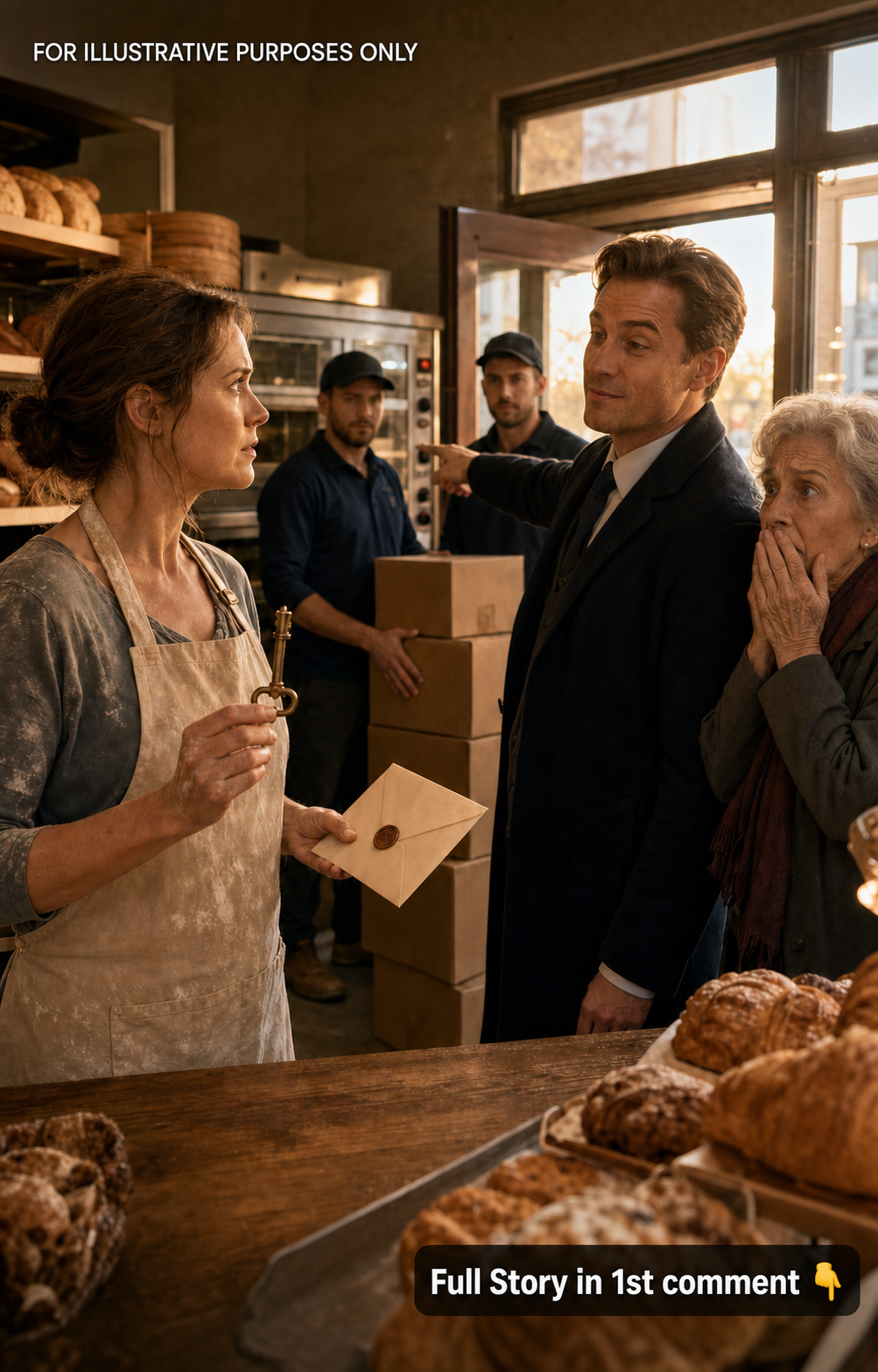
Victor reached for the letter, but I pulled it against my chest. “You said the bakery belongs to you,” I told him. “So why are you afraid of a room?” Mrs. Alvarez locked the front door while the movers exchanged uncomfortable looks. Grandma’s letter directed me to the oldest brick oven, the one nobody had used since the bakery was renovated in 1989. Behind its iron ash plate was a narrow keyhole. The brass key turned. A section of shelving released with a soft click. Behind it was not treasure, as Victor clearly expected, but a tiny office sealed beneath decades of flour dust. Inside stood a metal filing cabinet, a cassette recorder, and a framed photograph of Grandma beside a woman I did not recognize. I pressed play on the recorder.
Grandma’s voice filled the room. “Nora, if you are hearing this, Victor has tried to use the false deed.” Victor stopped breathing for a second. Grandma explained that Bellweather Bakery had never belonged to her alone. In 1981, when the bank refused to lend money to two unmarried women, her best friend Elena Alvarez—Mrs. Alvarez’s late sister—had provided half the purchase price. They created a private trust to own the building, protecting it from either family’s debts. The framed photograph showed them signing it. The original trust papers were inside the cabinet. Grandma had managed the property, but she could not legally leave it to Victor. The deed he carried transferred something she had never owned personally. “That’s ridiculous,” Victor said. “My lawyer filed it.” “Using June’s signature?” Mrs. Alvarez asked. He said nothing.
The final document was worse for him. Six months earlier, Grandma had recorded a notarized statement after Victor brought papers to her rehabilitation room. He told her they authorized repairs. They actually attempted to dissolve the trust and transfer the building to him. She had deliberately signed with her maiden name, making the fraud easy to prove. Grandma had not been confused. She had been building a trap. I called the trust’s attorney from the number in her letter. He arrived before noon with a title investigator. When Victor’s “deed” was compared with the trust records, the investigator contacted the county fraud unit. Victor’s confidence disappeared. The movers quietly unloaded every box.
Under the trust, Elena’s share had passed to a neighborhood food foundation. Grandma’s share passed to me—but only if I continued operating the bakery and trained two paid apprentices every year. I could never sell the building for a quick profit. That was exactly what Grandma wanted. Victor eventually admitted that he had planned to sell the property to a developer. The false filing was canceled, and he accepted a plea agreement that included restitution and community service. I did not celebrate his humiliation. Watching greed hollow him out was punishment enough. Six months later, I reopened the forgotten office as a small classroom called June and Elena’s Kitchen. Mrs. Alvarez cut the ribbon. The brass key now hangs above the old oven. Not because it opened a secret room. Because it reminded me that Grandma’s final gift was not a building. It was a way to ensure that nobody could ever again treat the people who built Bellweather Bakery as “only the help.”





Leave a Reply