Part 1: A Call Across the Desert
“My uncles beat me with a tire iron, Dad… and Mom just watched.”
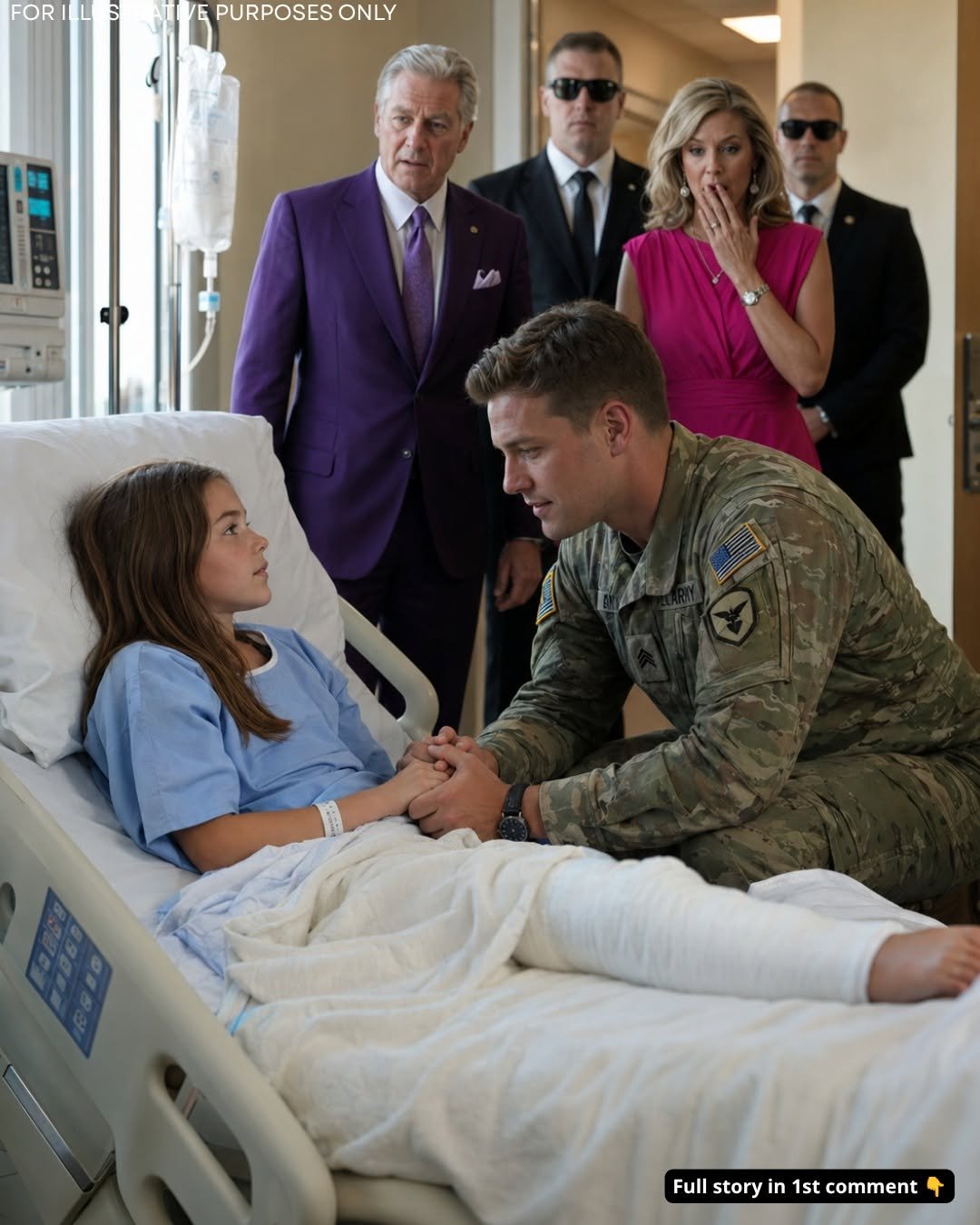
First Sergeant Marcus Vance felt the blistering Mojave Desert heat disappear beneath his boots. He was serving at a remote California training installation and was only two days from completing an eight-month deployment when his phone rang at 2:17 AM. The caller was Lily, his nine-year-old daughter. Her voice sounded so faint and fragile that he barely recognized it.
“I’m at the hospital in Asheville,” she whispered. “Everything hurts.”
Marcus didn’t raise his voice. Years in the military had taught him that when someone is already broken, panic from the person listening can make things worse. Keeping his tone steady, he told her to breathe slowly and explain exactly what had happened.
Rowan and Jaxson Sterling—his ex-wife Miranda’s brothers—had arrived drunk at the family estate in Sterling Falls, North Carolina. Lily accidentally spilled a soft drink on Rowan’s expensive leather boots. The two men dragged her onto the gravel driveway, pulled a heavy tire iron from their truck, and beat her one after the other while Miranda silently watched from an upstairs window.
“They took turns, Dad,” the little girl whispered before a nurse gently took the phone away.
The Hospital Reality
Twelve hours later, Marcus entered the pediatric intensive care unit. The attending physician, Dr. Jane Archer, spoke plainly.
Lily had suffered:
Fractures in both forearms.
Three broken ribs.
A shattered left femur.
Two crushed fingers on her right hand from trying to protect her face.
Doctors believed she would walk again, but nobody could say when she would finally sleep through the night without waking up in terror.
Sterling Falls was the kind of Appalachian town where everyone knew the truth but stayed silent. Charles Sterling owned the timber mill that employed much of the county, controlled Sterling Valley Finance—which held mortgages on most homes—and exerted influence through the local radio station and town council.
Sheriff Thomas Landry ate dinner at the Sterling estate every Sunday. Judges benefited from generous “campaign donations,” and inspectors regularly left the lumber yard with cash-filled envelopes.
Miranda had grown up believing the Sterling name placed her above consequences. During their short marriage, Marcus gradually realized that to the Sterlings, love often meant possession. Even after the divorce, despite joint custody, the family treated the court’s ruling as optional.
Marcus spent four painful days at Lily’s bedside, holding the only fingers not covered by casts. On the fourth afternoon, his phone rang. The caller was Evelyn Sterling, the family matriarch.
“I heard you’re back in town, soldier boy,” she said mockingly. “My boys are completely protected. My husband runs this county, the police force, and the courthouse. Take the girl when she’s discharged, and be grateful we’re letting you leave with her.”
Then she delivered a final warning:
“Rowan says that if you dare to come looking for him, he’ll finish what he started with her.”
Evelyn ended the call without realizing it had been placed on speaker and that Marcus, following years of military habit, had recorded every word.
He didn’t grab a weapon. He didn’t drive to the estate. He didn’t confront anyone.
Instead, he called his former commanding officer, Colonel Arthur Mitchell, and played the recording. After a long pause, the Colonel replied:
“Assemble your team, First Sergeant. But we aren’t going to war. We’re going to audit.”
That same night, while the Sterlings celebrated their sense of immunity, Brooke—Jaxson’s sixteen-year-old daughter and Lily’s cousin—sent an encrypted video to a burner number Marcus had created.
The footage showed Rowan, Jaxson, and Lily on the driveway.
It also showed Miranda standing at the upstairs window… before calmly drawing the curtains closed.
Part 2: Charting the Empire
Marcus gathered four trusted military brothers at a remote cabin near Fontana Lake. They wore no uniforms, but they worked with the precision of a tactical team.
Ivan Fletcher (Communications Specialist): Followed corporate holdings, tax records, and property ownership.
Matthew Caldwell (Intelligence Analyst): Connected county officials to hidden Sterling financial networks.
Thomas Mercer (Military Medic): Examined workplace injury records and medical documentation.
Bruno Briggs (The Muscle): Assigned one straightforward task—be present whenever the Sterlings attempted violence.
Within three days, the cabin walls were covered with a complete forensic map of the Sterling operation.
The scheme was methodical. Sterling Valley Finance trapped struggling timber workers in predatory loans. When injured employees fell behind, Sterling-owned companies seized their homes. Sheriff Landry helped conceal workplace accidents by altering emergency response records.
The family also operated a clinic where a corrupt doctor routinely overprescribed narcotics to keep workers compliant. Multiple overdose deaths had quietly disappeared from official scrutiny thanks to a county coroner who regularly socialized with Charles Sterling.
Brooke met with the team in secret. She revealed the location of secondary ledgers, identified vehicles used to move bribe money, and explained when politicians visited the estate.
Marcus’s group never stole evidence or tapped phones. They simply followed legitimate records and documented every trail left behind.
They supplied hidden incident reports to Deputy Iris Barr, one of the few honest deputies left. Lily’s medical files went to family attorney Victoria Caldwell. Financial records were handed to Federal Agent Rebecca Lomax, triggering investigations into fraud, money laundering, and civil rights violations.
The foundation of the empire began to crack.
Labor officials raided the timber mill without warning. Environmental agencies tested river water contaminated by mill waste. Federal healthcare investigators examined prescription records from the clinic. Charles Sterling spent heavily trying to identify a supposed business rival, unaware that his former son-in-law was quietly dismantling everything through legal channels.
Panicked by the threat to their power, Rowan and Jaxson chose the only solution they understood. Late one night, they arrived at the lakeside cabin.
Armed with steel pipes, they kicked in the front door.
Bruno Briggs waited inside. Thomas Mercer recorded from the staircase. Marcus stood behind the counter with his hands clearly visible.
The confrontation lasted fewer than ten seconds. The brothers ended up pinned to the floor without injury just as Deputy Iris Barr arrived silently in the driveway. They were immediately arrested for felony breaking and entering and attempted assault.
The footage was sent directly to federal prosecutors. Charles rushed to arrange an enormous bail package, moving large sums between accounts already under federal scrutiny. Each transfer generated more evidence.
Three days later, at exactly 5:58 AM, a convoy of unmarked federal vehicles entered Sterling Falls.
At the Sterling estate, Evelyn barely had time to ask who was at the door.
“Federal Bureau of Investigation. We have search warrants and arrest warrants.”
Charles glanced through the window and understood for the first time that none of the people stepping onto his property owed him anything.
Part 3: Measuring a Legacy
The first major blow to the Sterlings wasn’t arrest—it was silence.
For decades, every problem had been solved with a call, a payoff, or a threat. Yet that morning, no judge intervened, and Sheriff Landry could not stop the federal teams. The operation was being directed from Charlotte’s federal offices.
Agents searched the estate, the timber mill, the finance company, and the sheriff’s department simultaneously. Hidden behind a false wall in Charles’s office were ledgers filled with forged signatures, predatory contracts, and records of monthly payments to local officials.
The coroner cooperated within an hour. Sheriff Landry was arrested in front of his own deputies. For the first time in decades, residents realized the people they feared were finally being removed.
Charles and Evelyn were taken into custody together in their dining room. Still wearing the silk robe she had worn while mocking Marcus, Evelyn tried to sound confident.
“You have no idea who you’re dealing with,” she sneered.
The arresting agent calmly placed a portable speaker on the table and pressed play.
Her own words echoed through the room: “My husband runs this county, the police force, and the courthouse.”
Nobody reacted. The recording documented both her arrogance and her participation in intimidation and conspiracy.
Rowan and Jaxson soon faced upgraded federal charges. Brooke’s video, witness statements, and forensic evidence from the tire iron left virtually no defense. A landscaper testified he saw Rowan cleaning the weapon. A housekeeper admitted Evelyn had ordered blood removed from the driveway before emergency responders arrived.
The family attempted to portray Brooke as a bitter teenager. Lawyers offered her money and private university tuition in exchange for withdrawing her statement. Sitting beside a child advocate and a federal prosecutor, she listened before responding.
“My family taught me that being a Sterling meant you could break people and never get hurt,” Brooke said. “I don’t want the name anymore if it means I have to pretend I didn’t hear a little girl screaming for her life.”
The Final Audit
Over the following month, residents flooded the courthouse in Asheville with evidence. Workers described hidden injuries. Widows presented predatory contracts. Families documented how they had lost ancestral property.
Marcus never sought publicity. His mornings were spent at Lily’s physical therapy appointments, and his afternoons working with Victoria Caldwell on the custody case.
Lily’s recovery was slow and painful, but she gradually learned to walk again. The hardest moments came when she asked about her mother.
“Your mother made a terrible choice, Lily,” Marcus said while adjusting her wrist brace. “And adults have to take responsibility for their choices. You don’t have to carry any of her weight.”
Miranda was held separately from the rest of her family. Facing child neglect and accessory charges, she initially insisted she had been terrified of her brothers and father.
Victoria Caldwell remained firm.
“Fear explains your silence, Miranda. But it doesn’t repair your daughter’s broken bones.”
To avoid local influence, the custody hearing was moved to federal court in Raleigh. Judge Howard Beltran had already resigned after investigators discovered payments connected to his wife’s shell company.
The Sterling legal team attempted to portray Marcus as an unstable veteran pursuing revenge. Marcus responded by voluntarily releasing his military records, communications, and operational logs.
There were no threats, illegal tactics, or unauthorized actions. Everything had been documented through lawful whistleblower channels. Their argument only highlighted his discipline.
The night before her testimony, Miranda asked to see Marcus. They met in a secure federal conference room. She looked exhausted and hollow.
“I saw them take her out to the driveway,” she whispered. “Lily spilled the drink, and Rowan snapped. I wanted to run down the stairs, but my mother told me that if I interfered, she would cut off my trust and take my children. I heard the first blow. Then the second. I just closed the curtain, thinking that if I couldn’t see it, it wasn’t real.”
Marcus looked at her without emotion.
“But it was real, Miranda. And Lily was looking right at your window.”
Miranda accepted a plea agreement. She admitted guilt to accessory and child-endangerment charges and testified against her family and their associates. She received a suspended sentence, mandatory psychiatric treatment, and a permanent supervised restraining order preventing contact with Lily.
A Safe Home
Final sentences were delivered one year later.
Charles Sterling received 24 years in federal prison for racketeering, fraud, and conspiracy.
Rowan and Jaxson Sterling each received 18 years for aggravated assault and obstruction-related offenses.
Evelyn Sterling lost the estate, her wealth, and her influence before receiving a six-year sentence.
Sterling Valley Finance was dissolved, and forty-seven homes were returned to their rightful owners.
On the day sole custody was finalized in Raleigh, the weather was bright and cold. Lily walked out of the courthouse using a light cane.
Marcus knelt and zipped her coat against the wind.
“Are we going home now, Dad?” she asked.
“Yes, sweetie.”
“Which house?”
Marcus realized the meaning of home had been damaged for her just as much as her body had. He placed his hands gently on her shoulders.
“The one we’re going to build together,” he said. “A house where nobody ever closes the curtains when you ask for help.”
For a brief moment, Lily released her cane and wrapped her arms around his neck. As they headed toward his truck, she laughed softly—the first genuine laugh Marcus had heard since that call from the Mojave Desert.
Months later, Marcus retired from military service and became a regional search-and-rescue coordinator. Brooke earned a full scholarship to study civil rights law at Chapel Hill. In the center of Sterling Falls, residents replaced the old town charter plaque with a simple bronze marker.
It carried no Sterling names.
Instead, it displayed one message:
“A community’s strength is measured by how safely its children can speak.”
Marcus never fired a shot and never broke the law. He simply understood the system, gathered people willing to do the right thing, and allowed the truth to move forward on a path that money could no longer block.





Leave a Reply