Part 2
Five years before, Malcolm had started a charity called the Adrienne Davis Foundation.
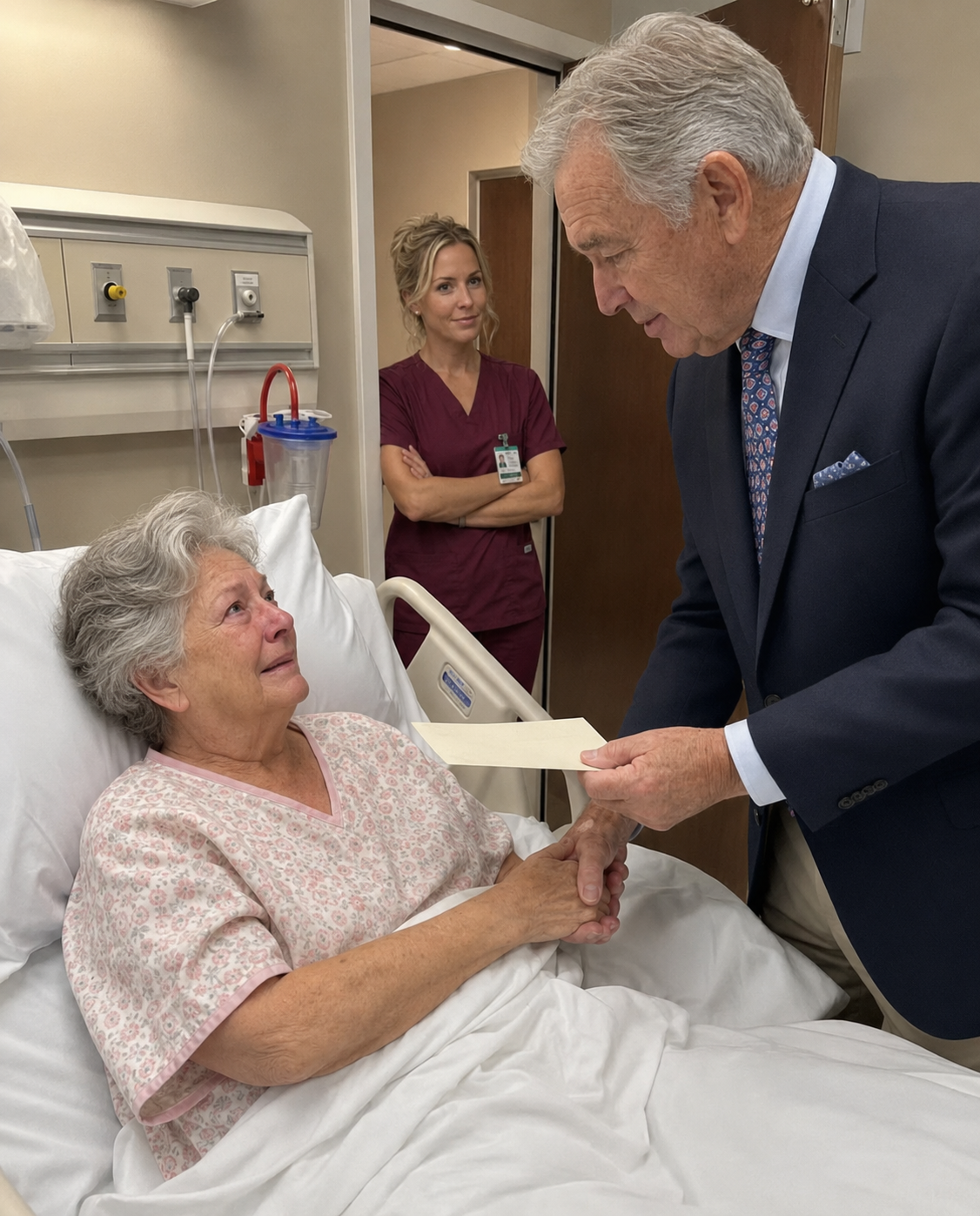
I stared at the letterhead.
“You named a foundation after me?”
“I hoped I’d eventually find you and ask if it was all right.”
He told me the foundation funded school meal programs and supported older adults who’d spent their lives helping others.
More than ten thousand kids had already eaten through programs tied to it.
I could barely take it all in.
“You did all this because I bought you lunch?”
“Because you showed me what kindness looked like.”
Then he slid another paper toward me.
“I’d like you to become executive director.”
I laughed, thinking he was joking.
He wasn’t.
The salary was $125,000 a year.
“Malcolm, I’ve never made anywhere close to that.”
“That’s not the point.”
He explained I’d have a staff running the administration and finances.
My job would be helping pick programs, shaping the mission, and keeping the foundation focused on the people it was built for.
More importantly, holding an active leadership role would make it nearly impossible for my children to claim I lacked mental capacity.
Then Malcolm pulled out photos of a lovely single-story home in Sunset Gardens.
A peaceful community built for independent older adults.
“You bought this?”
“For you, if you’d like it.”
“Malcolm, I can’t take a house.”
“Why not?”
“Because it’s too much.”
He looked at me.
“When you fed me for two years, did you expect anything back?”
“No.”
“Then why can’t you believe I want to help you the same way?”
I had nothing to say to that.
The house was paid off completely.
No mortgage.
No rent.
Support services were there if I ever wanted them, but I could live entirely on my own.
Then Malcolm showed me one last document.
A draft will.
It moved my modest estate away from my children and toward scholarships and charitable work.
It also named, clearly, who would be responsible for my care if I ever truly lost the ability to make decisions.
“This leaves my children with nothing.”
“That can change,” Malcolm said right away. “Every piece of this is your call.”
He paused.
“If you decide tomorrow that you want to forgive them and leave them everything, I’ll still stand behind you.”
“Even if you don’t agree with it?”
“Yes.”
“Why?”
“Because helping someone isn’t the same as controlling them.”
Those words hit hard.
My children claimed they wanted to “protect” me.
Malcolm wanted to protect my right to choose.
That was the difference between them.
Then a nurse knocked.
“Mrs. Davis, your three children are here.”
My heart monitor picked up its pace at once.
Malcolm noticed.
“You don’t have to see them.”
I glanced at the papers.
Then at him.
“Send them in.”
Malcolm gathered up the documents.
“Should I stay?”
“Wait outside.”
He nodded.
“Call me if you need me.”
Before he stepped out, I stopped him.
“Malcolm?”
He turned back.
“Thank you for remembering me.”
He smiled.
“Thank you for giving me something worth remembering.”
Moments later, I heard my children coming down the hall.
David’s voice came first.
Sarah sounded on edge.
Michael was joking around.
Then the door swung open.
David walked in wearing his best navy suit.
Sarah carried a bouquet that looked like it had come straight from the hospital gift shop.
Michael had his eyes fixed on his phone.
Sarah rushed toward my bed.
“Mom! How are you? We’ve been so worried.”
I looked at her.
“I’m fine.”
David stood at the foot of the bed.
“We talked to your doctor. Everything went perfectly.”
“So I heard.”
Michael glanced up.
“You look pretty good considering.”
“Thank you, Michael.”
Then David took a seat.
“We need to talk about some practical things.”
There it was.
The real reason they’d come back.
Sarah wrung her hands.
“We’re worried about you living alone after all this.”
“After what, exactly?”
“You had heart surgery.”
“One blocked artery. My doctor expects a full recovery.”
David shook his head.
“Mom, you’re sixty-four.”
I nearly laughed.
He said it like I was ninety-four.
Sarah leaned in.
“We’ve looked at a few places.”
“What places?”
“Assisted-living communities.”
I looked at them both.
“You’ve already looked into where you want me to live?”
David’s patience was wearing thin.
“This is about keeping you safe.”
“Is it?”
Michael finally glanced up.
“Mom, independence is great when you’re healthy.”
“I am healthy.”
“You just had surgery.”
“And I’m expected to recover fully.”
David leaned forward.
“You need to think about your finances too.”
There it was again.
I stayed silent.
He kept going.
“Medical care isn’t cheap. You can’t keep living on your own forever.”
“And what do you propose?”
Sarah jumped in.
“You could sell the house and use the money for assisted living.”
“And once that money’s gone?”
David shrugged.
“Medicaid.”
I looked at them, stunned.
They’d planned it all out.
Sell my house.
Drain my savings.
Move me wherever they decided.
Then let the state pick up the bill eventually.
“How long have you three been talking about this?”
David’s eyes flickered.
“We’ve done a little preliminary research.”
“With lawyers?”
His expression shifted.
“Why would you ask that?”
Before I could respond, Malcolm knocked and stepped in.
David shot to his feet.
“Are you one of Mom’s doctors?”
Malcolm offered his hand.
“Malcolm Chen.”
Then, calmly, he added:
“I own this hospital.”
The change in my children was almost comical.
David turned instantly charming.
Sarah straightened up.
Michael finally set his phone down.
David shook Malcolm’s hand with sudden enthusiasm.
“We’re so grateful for the wonderful care our mother’s received.”
Malcolm smiled politely.
“Your mother is a remarkable woman.”
Sarah nodded eagerly.
“She really is.”
I could hardly believe what I was watching.
Then David tried to work an angle.
“Mr. Chen, maybe you could give us some advice. We’re thinking about assisted living for Mom.”
Malcolm glanced my way.
“And what does Mrs. Davis want?”
David hesitated.
“She’s resistant.”
Malcolm nodded slowly.
“In my experience, people tend to heal better when they stay involved in decisions about their own lives.”
Sarah agreed quickly.
“Absolutely. We want her involved.”
Malcolm’s smile barely moved.
“Good to hear.”
Then he turned to me.
“Mrs. Davis, do you feel able to make decisions about your own recovery?”
I met his gaze.
“More able than I have in years.”
“Excellent.”
Before leaving, he added:
“Call me if you need anything at all.”
Once he left, David stared at the closed door.
“Why is the hospital owner personally checking on you?”
I shrugged.
“Maybe he just cares about patients.”
David didn’t seem convinced.
Then I turned to my children.
“You know, maybe you’re right.”
All three of them snapped their attention to me.
“I should probably start making some changes.”
David beamed.
“That’s exactly what we’ve been telling you.”
I smiled back.
“Yes.”
But the changes I had in mind looked nothing like what they were picturing.
Part 3
Six months later, I stood on my porch at Sunset Gardens with a cup of coffee, watching the morning mist rise off the lake.
My life looked completely different now.
Within a week of leaving the hospital, Malcolm’s team had helped me move.
My old place was boxed up.
Everything I wanted came along.
Everything I didn’t need went to charity.
My children were told I’d moved into a senior community for health reasons.
Technically, that much was true.
What they didn’t know was that this wasn’t the modest assisted-living place they’d pictured.
My home was paid for in full.
No mortgage.
No rent.
And my paycheck from the Adrienne Davis Foundation was almost ten times what I used to live on.
I’d also taken the executive-director role.
My days filled up fast.
I reviewed applications for school lunch programs.
Helped fund scholarships.
Met with community groups.
Talked through new programs with architects and nonprofit leaders.
For the first time in decades, I wasn’t figuring out which bill I could put off.
I was figuring out how many kids we could feed.
Then one morning, a letter came from David.
He wrote that he was worried because I hadn’t called much.
He wanted to come see me.
And, of course, he wanted to talk about my money.
I laughed reading that part.
He still thought I needed him managing my finances.
Later that morning, Malcolm called.
“There’s something you should know.”
“What is it?”
“Someone reached out to the foundation yesterday asking about your job.”
My stomach dropped.
“What did they want to know?”
“Your salary. Your responsibilities. Whether you seem mentally capable of handling the role.”
“David.”
“That’s my guess too.”
Malcolm told me his staff had confirmed I was an active executive in good standing.
No red flags.
No confusion.
No incompetence.
Then he mentioned an elder-law attorney had reached out to him as well.
David had apparently kept asking lawyers whether my new job could be a sign that someone was manipulating me.
I looked out across the lake.
“He’s still at it.”
“Yes.”
“Can he actually do anything?”
“No.”
Malcolm answered without hesitation.
“You live independently. You’re employed. You’re making complicated decisions every day. You’re clearly competent.”
Relief flooded through me.
Then something surprising happened.
I realized I didn’t feel guilty at all.
For years I’d believed being a mother meant endlessly cleaning up my children’s messes.
Paying off debts.
Handing over money.
Making excuses.
Now I’d stopped.
And it felt like freedom.
“Any regrets?” Malcolm asked.
I thought it over.
“I regret that it ever came to this.”
I paused.
“But I don’t regret choosing myself.”
“Good.”
A few weeks later, I met Malcolm’s daughter, Jennifer.
She was a college student writing a paper on charitable organizations and wanted to interview me about the foundation.
We had lunch together.
Sitting across from her, something clicked.
I was forming relationships that had nothing to do with guilt or obligation.
People valued my experience.
My judgment.
My kindness.
Not my bank balance.
One afternoon, my neighbor Mrs. Patterson and I were eating lunch together when she said something I’ve never forgotten.
“You know why I love living here?”
“Why?”
“Because everyone here chose this.”
I looked at her.
“We’re not here because our kids dumped us somewhere. We’re here because we finally decided we deserve a beautiful life too.”
That evening, I went home and wrote a letter.
Dear David, Sarah, and Michael,
I want you to know that I am healthier and happier than I have been in years. My home is comfortable. My finances are secure. I have meaningful work that gives me purpose every day.
I understand that the choices I’ve made may not be the ones you expected.
But they are mine.
I do not need anyone to manage my money.
I do not need anyone to decide where I should live.
And I am not being taken advantage of.
I hope each of you builds a happy life of your own.
Love, Mom.
Then I added one last note.
P.S. I’m enclosing information about the Adrienne Davis Foundation. We are always looking for volunteers if any of you ever decide you’d like to help feed children who need it.
I signed the letter.
Sealed it.
And finally stopped explaining myself.
That night, I stood by my bedroom window looking out over the gardens.
On the table beside me sat Malcolm’s old school lunch card, now framed.
A tiny, faded scrap of paper that had somehow survived decades.
At sixteen, I’d thought I was simply feeding a hungry little boy.
I never imagined that small act of kindness would travel forty years, grow into hospitals and foundations and thousands of meals, and then somehow circle back around when I needed kindness most.
Six months earlier, I’d woken from heart surgery completely alone.
My own children had left because they saw my life as something to manage and my money as something they’d eventually inherit.
Now I lived somewhere I felt respected.
I had work that mattered.
Friends who valued me.
And control over every decision that was mine to make.
It took heart surgery for me to finally understand something simple:
My children didn’t get to decide my worth.
My age didn’t erase my independence.
And generosity was never proof that I was losing my mind.
Sometimes kindness slips out into the world and you never know what becomes of it.
And sometimes, decades later, it makes its way back to you.





Leave a Reply